


This is the first post of a 10-part series: AI Reality Check for Grocers.
🛒The grocery industry is talking about AI the same way it once talked about omnichannel. As the thing that will fix everything. Margins. Labor. Growth. Loyalty. All in one move. Every conference panel, every trade publication, every vendor pitch deck is telling the same story: AI is the answer. Just trust the algorithm.
This is not the first time grocery has bought the pitch.
AI is real, and it will absolutely change parts of the grocery experience. Search will improve. Substitutions will get smarter. Marketing will get more efficient. Personalized offers will actually feel personal instead of just slightly less generic.
None of these is the core problem, and solving them won’t fundamentally change the economics of running a grocery business.
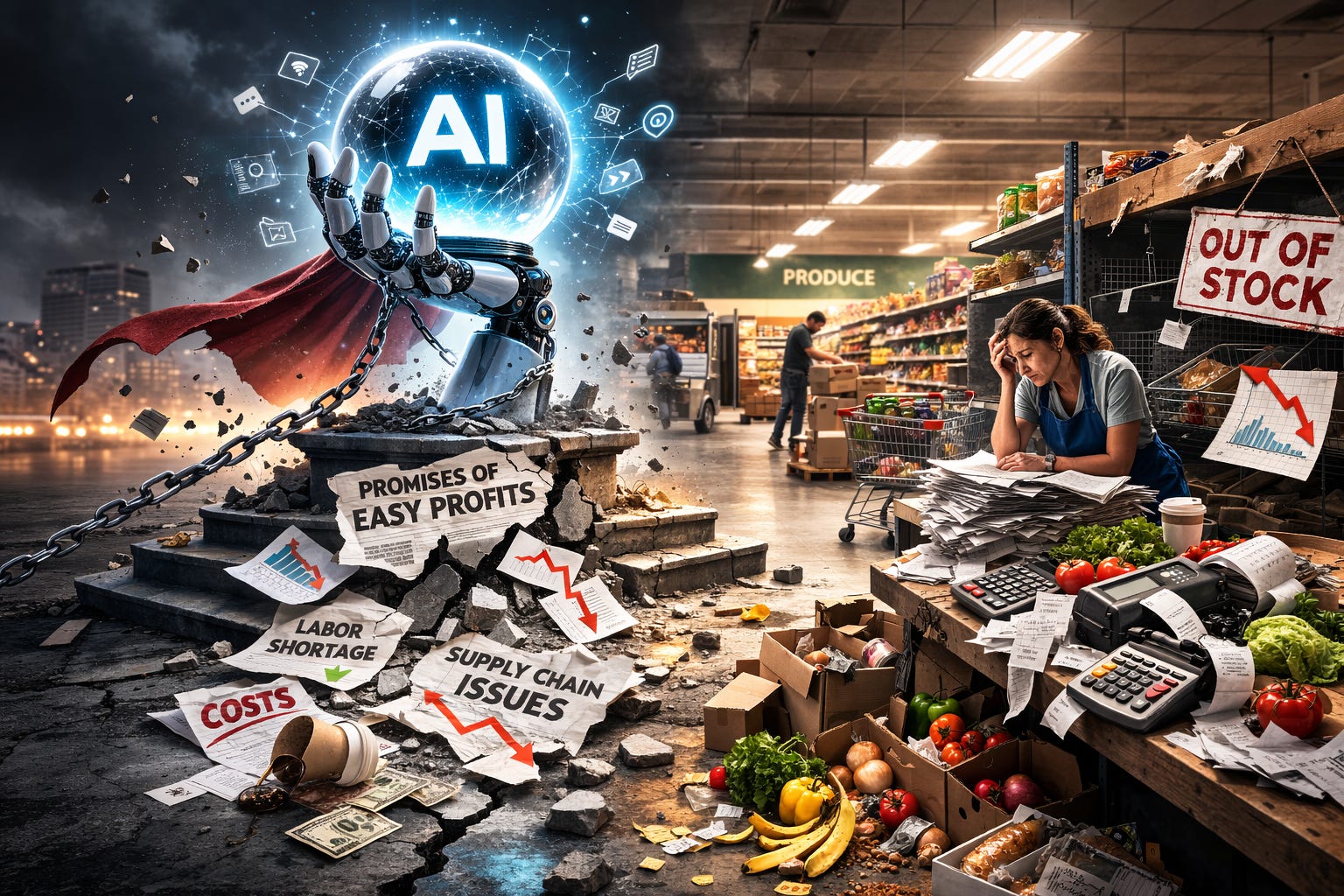
Grocery doesn’t struggle because it lacks intelligence. It struggles because the economics are already brutal.
Net margins of 1-3% are common1. Labor is constrained, expensive, and churning, and post-pandemic expectations around wages aren't going back. Shrink keeps eroding profitability, and it’s getting worse in many markets. Supply chains are still volatile, and COVID exposed fragilities that nobody has actually fixed.
AI doesn’t remove those constraints. It operates inside them. That distinction gets glossed over when someone's trying to sell you a platform.
Most AI investments in grocery are concentrated on the digital layer: recommendations, chatbots, personalization, and search. These are real capabilities. They’re also the easiest to build, the easiest to demo, and the easiest to sell to a board that wants to feel like it’s making a bet on the future.
But digital is still a minority of total grocery revenue. Grocery ecommerce penetration is around 14-15% in the U.S2. The majority of the business, the vast majority, is still happening in physical stores, in aisles, at checkout, in the back room, and on the loading dock.
⚠️So we have a real mismatch. The industry’s most advanced technology is being applied to its smallest slice of revenue, while the rest of the operation runs mostly the same way it did a decade ago.
On-shelf availability is still a mess, and out-of-stocks cost retailers billions annually. Forecasting is inconsistent enough that over- and under-ordering happen in the same week. Labor allocation is still more art than science. Fresh shrink compounds quietly until someone runs the numbers and winces.
These aren’t flashy problems. They don’t demo well at a conference. But they’re where the money is, and they have been for thirty years.
Grocery doesn’t need AI to grow. It needs AI to survive.
Everyone’s selling AI as a growth lever. In grocery, that’s the wrong frame. A 2% margin business doesn’t have a growth problem; it has a bleeding problem. AI can help stop the bleeding. That’s genuinely valuable work.
But survival and growth are different stories, and mixing them up is expensive. Growth stories attract investment, talent, and attention. Margin preservation stories attract auditors. Misread which one you’re in, and you end up with a great chatbot and the same structural problems.
The retailers who win with AI won’t be the ones with the most visible AI strategy. They’ll be the ones who quietly apply it where it’s hardest to see and hardest to copy: reducing waste at the store level, improving in-stock rates through better demand sensing, and optimizing labor scheduling against actual traffic patterns.
That kind of advantage doesn’t show up in a press release. It shows up in the P&L.
Unsexy work. High leverage.
AI won't save grocery. Good operators will. The ones who skip the press release and fix the back room will quietly out-margin everyone who bought the pitch.
💰In a 2% margin industry, that’s not a small thing. That’s the whole game.
Curious how others are seeing this play out. Where are you seeing real AI impact in grocery today, and where is it mostly noise?
AI Reality Check for Grocers is a 10-part series that cuts through the hype and focuses on where AI actually creates value, from the shelf to the supply chain.
“Grocery industry profit margins fall to pre-pandemic levels: FMI.” Grocery Drive: https://www.grocerydive.com/news/grocery-industry-profit-margins-fall-to-pre-pandemic-levels-fmi/720517
“U.S. eGrocery Sales Surge 32% YOY to a Record $12.7 Billion in December 2025.” Bricks Meets Click: https://www.brickmeetsclick.com/presses/u-s-egrocery-sales-surge-32-yoy-to-a-record-12-7-billion-in-december-2025