


This is the first post of a 10-part series: The Marketplace Trap.
I've watched grocers celebrate massive digital growth, but few are asking what that growth actually costs in customer ownership. For the last decade, they have focused heavily on digital. Launch the app. Enable delivery. Increase eCommerce penetration. Partner with marketplaces.
In many cases, those investments have worked. Digital revenue has grown, online adoption has accelerated, and marketplace partnerships have expanded geographic reach and convenience. But there’s a deeper question most organizations aren’t asking:
Is digital growth strengthening profitability, or transferring it to third parties?
Digital penetration is often celebrated as a headline KPI. 10%, 15%, 20% of total online sales. Yet penetration alone says nothing about contribution margin, customer ownership, or long-term economic structure. If high-value omnichannel households increasingly transact through third-party platforms, several structural shifts quietly occur:
Search control moves outside.
Loyalty goes elsewhere.
Retail media revenue disappears.
Behavioral data is lost to the platform layer.
Customer relationships become owned by the platform, not the retailer.
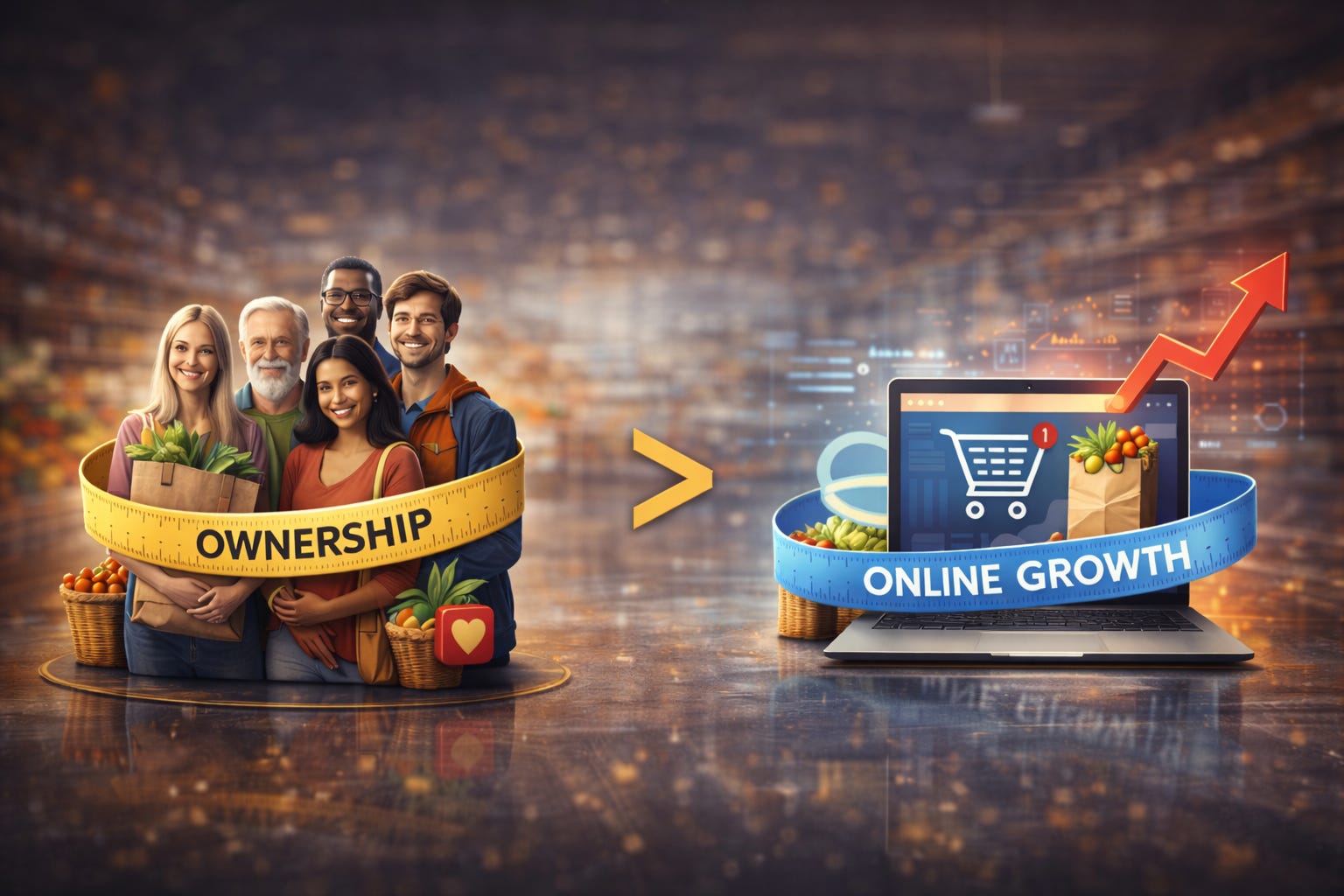
Revenues may increase, but ownership transfers. Those two outcomes are not the same.
Let’s look at the numbers:
A strong omnichannel grocery household might generate approximately $62,000 in revenue over five years.
At a blended 3% contribution margin, that equates to roughly $1,800 in profit.
With heavy marketplace usage, commissions, platform fees, and shared retail media economics, the effective contribution margins drop from 17% to 8%.
That same household may now generate closer to $800 in contributions over five years.
That $1,000-per-household delta compounds quickly across hundreds of thousands of customers, representing tens of millions in value shifted from the grocer to third parties.
This is not a short-term revenue optics issue. It is a long-term structural margin issue.
Retail media further complicates the equation. Grocery margins are thin, but retail media margins are not. Sponsored search, audience targeting, and closed-loop attribution are becoming some of the highest-margin components of digital grocery. When third-party platforms control discovery and sponsored placement, they are not simply facilitating transactions. They are owning the most profitable layer of the stack. That shift has strategic implications that extend far beyond delivery logistics.
Third-party marketplaces provide real value:
They accelerate customer acquisition.
They capture incremental demand.
They extend coverage into low-density markets.
They reduce capital intensity in last-mile infrastructure.
They are powerful partners. But they are also powerful platforms that accumulate more control over time. The opportunity for grocers is to partner strategically while maintaining independence where it matters most: their bottom line.
True digital strength in grocery is not measured by penetration percentages. It is measured by ownership. Retailers can strengthen ownership by:
Knowing who your customers are across every channel they shop.
Focusing on long-term customer value, not just this quarter’s digital revenue.
Using marketplaces to find new customers, not to keep existing ones.
Owning the advertising revenue generated by your customer traffic.
Negotiating deals from a position of choice, not dependence.
The next five years in grocery will be won by retailers who understand platform economics and protect their customer relationships accordingly. Those who treat marketplaces purely as vendors may eventually realize they have outsourced more than logistics. They have outsourced ownership.
And ownership, once transferred, requires significant investment to reclaim.
The Marketplace Trap is a 10-part series on why mid-tier grocers are handing customer ownership to platforms, and what they can do to take it back.
The full series: