


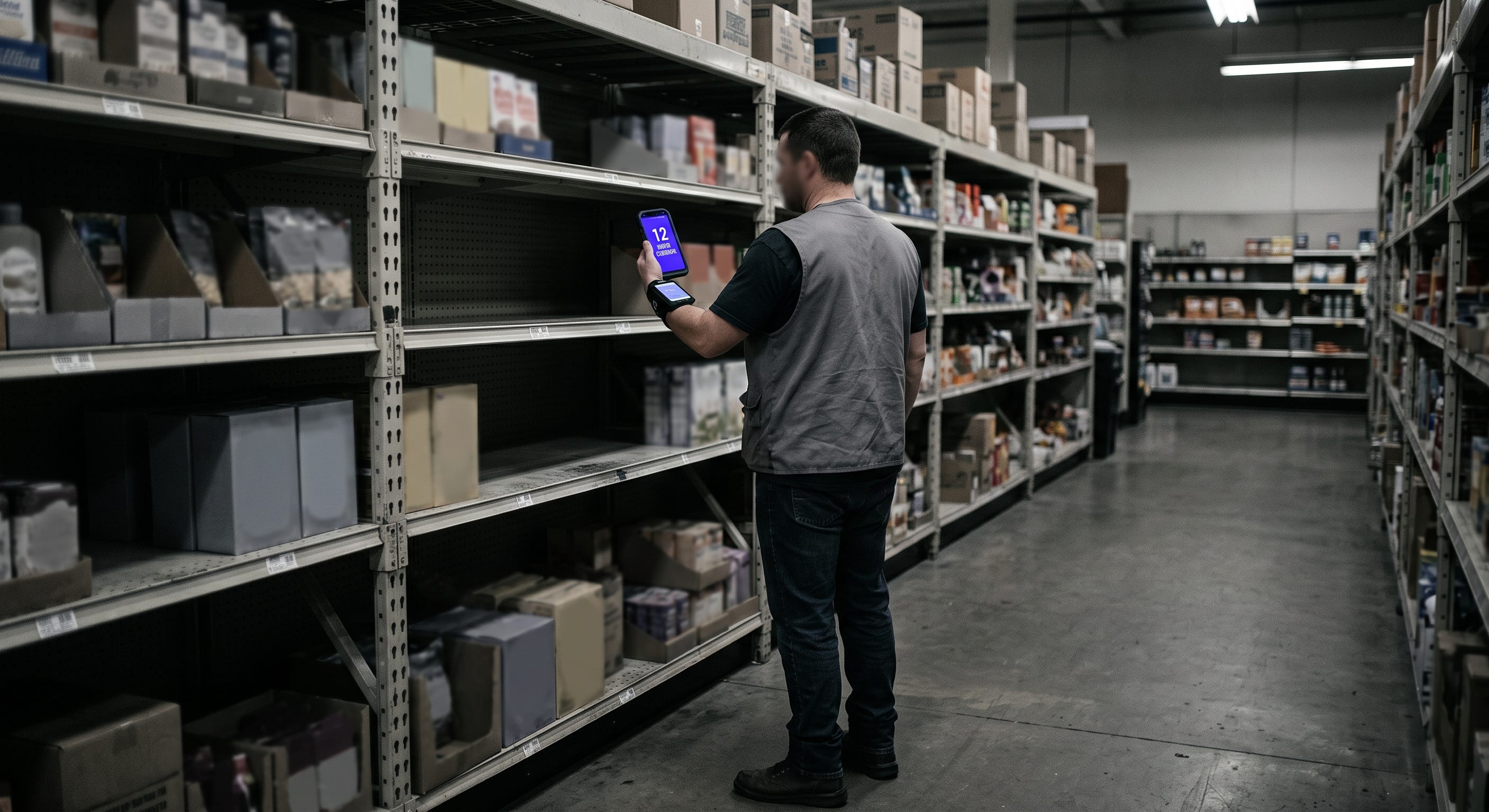
A picker walks into a Kroger, pulls up an order, heads to the dairy cooler, and the shelf holding the chocolate milk is empty. The app reroutes. The substitution goes out. The customer gets frustrated. That friction, repeated across millions of orders each week, is where grocery economics quietly bleeds out by the billions each year.
Instacart just bought a fix for that. And it’s a much bigger deal than their press release made it out to be.
Why POS data doesn’t solve this
Here’s a question that sounds like it should have an obvious answer: don’t grocery stores already know what’s on their shelves? They scan everything at checkout. Sell three cans of soup, and the system knows three fewer cans exist.
The problem is that sell-through data tells you what left the store, not what’s on the shelf right now. Inventory counts constantly drift from reality due to shrink, misplaced products, vendor mispacks, employee errors, and theft. Columbus Consulting estimates that 56% of grocery inventory records are actively inaccurate at any given moment.1 The system says 12. The shelf says zero.
“System real time” and “shelf real time” are not the same thing for most grocers. The only way to know what’s actually there is to look, and that meant manual audits on a fixed schedule.
Instacart’s acquisition of Arpalus gives it a computer vision system that turns standard smartphones into shelf-scanning hardware with better-than-95% accuracy. Point a phone at a shelf, and Arpalus maps what’s there, item by item, in real time.
Instacart’s plan is to pipe that into its 600,000-plus shopper network, turning every order fulfillment into a passive shelf audit. A continuous, physical feedback loop on what’s actually in stock.
No grocer has built this at scale. Instacart is about to.
The found rate is the number that matters
There’s one operational metric at the center of all of this, and most grocery tech investments ignore it: the found rate.
The found rate is the percentage of ordered items a shopper actually locates and delivers. Every missed item costs a substitution, a support ticket, or a lost customer. A grocer can build a beautiful personalized recommendation engine and still bleed money on every order if the found rate is soft.
Arpalus directly protects that number by giving pickers real-time intelligence on what’s available, so they don't waste time searching for product that isn’t there.
Consumer-facing AI doesn’t touch this metric. That’s the whole problem.
The number grocers don’t like to say out loud
Out-of-stocks are costing North American food retailers 5.9% of total retail sales, according to IHL Group.2 On margins that already sit between 1% and 3%, that’s not a rounding error. That’s the difference between a good quarter and a bad year. And a loyalty program with points and tiers doesn't survive one too many substitutions.
The customer damage compounds fast in digital channels. A shopper who places a delivery order expects the items they ordered. When substitutions stack up, they don’t complain; they switch. According to FMI, the average American household shops at 5.4 different grocery banners per month.3 Switching costs nothing.
The pyramid problem
If you’ve read The Grocery AI Pyramid, you know the argument. Most grocery AI budgets flow toward the top of the stack: personalized search, generative shopping assistants, chatbots, and other consumer-facing features look good in demos. But the bottom of the stack gets treated like infrastructure nobody wants to put on a roadmap: demand forecasting, inventory accuracy, shelf availability.
Consumer-facing AI is visible. You can screenshot it, show it to a board, and put it in a press release. Shelf data infrastructure is invisible until it fails, and when it fails, it gets filed under ops, not technology. So the budgets keep going to the top.
Instacart buying Arpalus is a direct shot at the bottom. A personalized recommendation engine is worth nothing if the item isn’t on the shelf when the picker goes to grab it.
The part grocers should be worried about
Instacart is building the most accurate, continuously updated map of physical shelf inventory across thousands of stores. They’ll use their own shoppers, their own technology, and even their own carts. The data belongs to Instacart.
CPG brands already pay serious premiums for shelf positioning and promotion compliance data. The grocer who controls that data has pricing power. The grocer who outsources fulfillment to a platform running its own shelf-intelligence layer has handed over that leverage, along with the customer relationship and the delivery margin. It’s a slow transfer, and most operators don’t notice until the renewal conversation.
Caper Carts extend the reach. They’re now deployed in 100 cities across 15 states, with Instacart tripling their store count in 2025. In stores where the carts are running, every pass through an aisle silently updates the shelf map. The more stores adopt, the harder it is to unwind the dependency.
What the acquisition actually signals
With the Arpalus acquisition, Instacart is building at the bottom of the pyramid, while grocers keep spending at the top. The gap doesn't close while you're busy perfecting your chatbot.
“Inventory, a Perpetual Problem or New Opportunity?” Columbus Consulting: https://www.columbusconsulting.com/insights/inventory-a-perpetual-problem-or-new-opportunity
“Out-of-Stocks Cost Grocery Retailers Billions.” The Food Institute: https://foodinstitute.com/retail/out-of-stocks-cost-grocery-retailers-billions
“U.S. Grocery Shopper Trends 2026.” FMI: https://www.fmi.org/our-research/research-reports/u-s-grocery-shopper-trends