


This is the fifth post of a 10-part series: The Marketplace Trap. If you are jumping in here, the first post is the right place to start.
There's a belief running through grocery boardrooms that's costing mid-tier grocers real money: they think they’re losing before they even start.
They look at Kroger’s technology budget or Amazon’s logistics machine and conclude the game is rigged. It’s not. They’re just measuring themselves with the wrong ruler.
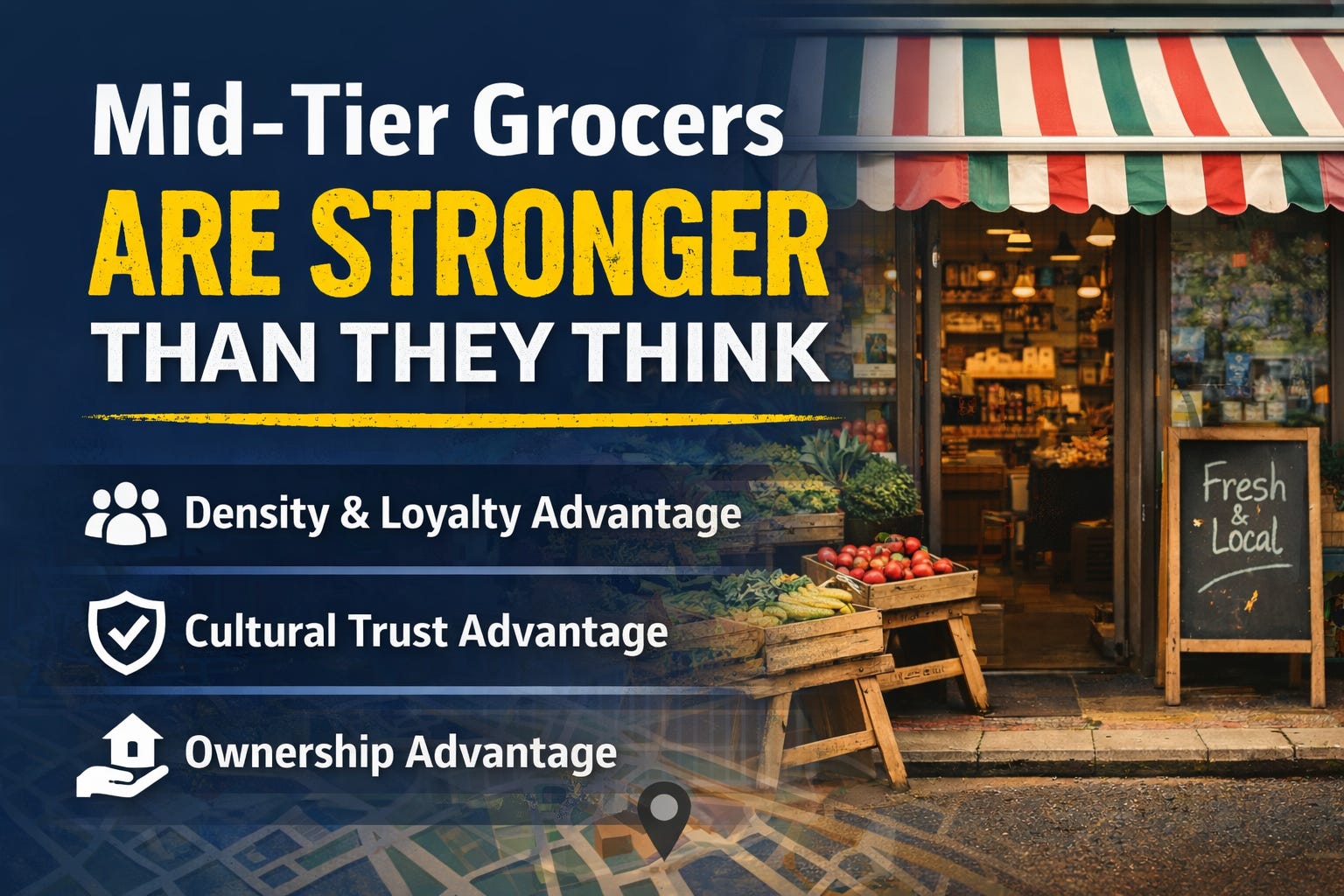
Scale matters in grocery. Nobody’s denying that. But scale is one type of power, not the only type. Density, trust, and cultural relevance are just as real, and mid-tier grocers have them in abundance without realizing it.
At 35% metro share1, you're not competing for the market. You are the market.
When marketshare is concentrated, customer acquisition gets cheaper because everyone already knows you. Loyalty penetration climbs within core ZIP codes. Promotions actually land because they’re built for this neighborhood, not a composite of 40 markets.
A national chain’s 8% national share2 is reach. Not grip.
The strategic move for mid-tier grocers is not chasing geographic expansion. It is deepening control where they already dominate. In practice, that looks like:
Drive loyalty enrollment above 75% in your core ZIP codes.
Invest in your own pickup infrastructure and partner with delivery providers who can work within your existing density.
Run hyper-local promotions tied to neighborhood events, local sports teams, or seasonal rhythms that a national planner sitting in Cincinnati would never think to run.
Regional grocers have something else too: precision. They know which neighborhoods go price-sensitive in January. They know which products move during Lunar New Year versus Easter. Their feedback loop is faster. Their vendor relationships are closer. And a markdown decision does not require five layers of approval.
That agility is not a consolation prize. It’s a competitive weapon.
The practical expression of that advantage is shorter merchandising cycles. Test in two stores this week. Read the data. Roll out next week. National competitors operating across 40 markets cannot move that quickly without friction.
Ethnic grocers take this even further. Their differentiation isn’t about price. It’s about identity. For many households, their stores aren’t a fallback option. They’re the only option that feels right. That kind of loyalty doesn’t show up in market share reports, but it absolutely shows up in retention.
For many households, these stores are not interchangeable options. They are primary destinations anchored in culture and familiarity. That kind of loyalty does not always appear in marketshare dashboards, but it shows up in retention and basket consistency.
You can’t buy cultural trust. You either have it or you don’t.
The opportunity is to make that identity even more explicit. Invest in community programming, local cultural events, and teams that reflect the neighborhoods being served. Build an owned loyalty program that tracks what matters specifically to these households, not a generic points scheme copied from a national template. The assortment advantage is already there. The relationship infrastructure often isn’t fully built yet.
The digital inferiority complex is where many mid-tier grocers miscalculate. They see AI headlines and assume they’re behind the curve.
But digital ROI isn’t about who has the largest engineering team. It’s about who owns the relationship in the markets they serve. A focused grocer can drive higher digital penetration in 15 ZIP codes than a national chain can manage across 500.
Focus beats mass. Every time.
The strategic shift is from renting attention from third-party vendors to owning it. Here’s how mid-tier grocers can cement those relationships digitally:
Drive 80%+ loyalty identification in core ZIP codes.
Make the mobile apps the default entry point for coupons and trip planning.
Use purchase history to shift from mass offers to household-level pricing.
Build a retail media offering that lets local and regional brands reach your specific audience, something a national platform can't replicate. That's a new revenue stream, not just a marketing tool.
None of this requires a nine-figure technology budget.
It requires discipline around customer ownership.
The real danger for mid-tier grocers isn’t lack of scale. It’s believing the false narrative that scale is everything. Once leadership accepts that story, their decisions follow common mistakes: outsource the growth, lean heavily on third-party demand, and underinvest in owned loyalty.
Over time, their density erodes and customer ownership thins.
That’s not a size problem. It’s a confidence problem.
The grocers who fix that confidence problem first will find the path forward is shorter than they expected. The future of grocery isn’t winner-take-all nationally. It’s winner-take-most locally. In many markets, mid-tier grocers are already in that position.
The grocers who recognize this and invest accordingly will quietly compound profitability over time.
The Marketplace Trap is a 10-part series on why mid-tier grocers are handing customer ownership to platforms, and what they can do to take it back.
The full series:
U.S. grocery markets are highly regionalized, with many metropolitan areas dominated by one or two chains holding 30–40%+ local marketshare, even though national share appears fragmented.
Sources:
“U.S. Grocery Market Share and Competitive Landscape.” Coresight Research: https://coresight.com/research/us-grocery-retailing-market-forecast-and-competitive-landscape
“The Food Retailing Industry Speaks 2025.” FMI: https://www.fmi.org/our-research/research-reports/food-retailing-industry-speaks
The U.S. grocery market remains highly fragmented, with most chains holding low national share but strong regional dominance.
Sources:
“Market Navigator: US Grocery Retailing.” Coresight Research: https://coresight.com/research/market-navigator-us-grocery-retailing-igniting-unit-growth-in-a-low-inflation-environment
“The PG 100: Annual Ranking of Top Food Retailers.” Progressive Grocer: https://progressivegrocer.com/pg-100-annual-ranking-top-food-retailers