


This is the third post of a 10-part series: AI Reality Check for Grocers. It’s best to begin with the first post if you jumped in here.
Grocery executives love a good AI demo. A chatbot that helps you find recipes. Personalized search that surfaces the oat milk you bought last March. A recommendation engine that nudges you toward the $12 olive oil.
But they also share a quiet problem: they’re mostly optimizing the smallest part of the business.
Even for the most sophisticated omnichannel grocers, eCommerce still accounts for a minority of total revenue. So the most sophisticated AI ends up getting applied to the smallest slice of the economics. That’s not an indictment. It’s just math. And it points to a much bigger opportunity that most retailers are underinvesting in.
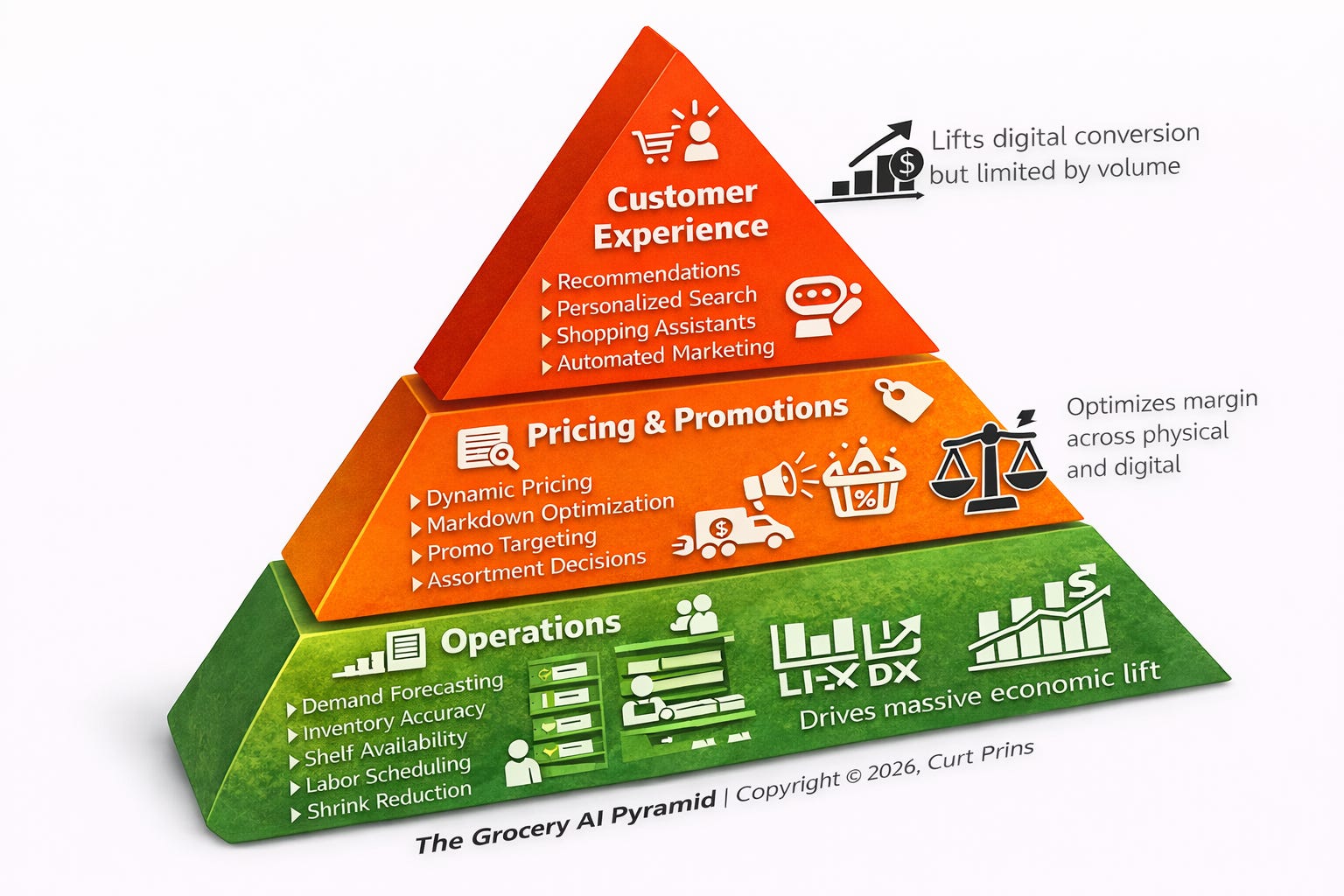
Think about grocery AI as a pyramid with three layers:
🟥At the top, you have customer experience: recommendations, personalized search, shopping assistants, and automated marketing. These tools can genuinely lift conversion and basket size, but their impact is limited by how much of your volume actually flows through digital channels.
🟧The middle layer is pricing and promotions: dynamic pricing, markdown optimization, promo targeting, and assortment decisions. This is where things get more interesting, because this layer touches margin across both digital and physical. Better promo targeting reduces waste. Smarter pricing protects margin without sacrificing volume. The upside is larger, but the organizational lift is harder, the data is messier, and the feedback loops are slower.
🟩Then there’s the bottom of the pyramid, where the real economic gravity lies. Demand forecasting. Inventory accuracy. Shelf availability. Labor scheduling. Shrink reduction. None of this is flashy. You cannot demo “better in-stock rates” the way you demo a chatbot. But the numbers here are staggering.
In the U.S. grocery industry alone, stockouts cost an estimated $15 to $20 billion a year, roughly 3% of total sales1. And in 2025, 73% of U.S. shoppers said they would switch stores if a key item was unavailable2. At scale, that's not a supply chain problem. It's a customer retention problem.
So why does the top of the pyramid get most of the attention? A few consistent reasons. Customer-facing AI is visible. You can launch it, market it, and point to it in a press release.
Operational AI is invisible when it works, and very visible when it fails, so it tends to attract more scrutiny and less credit.
There's also an organizational boundary problem. Customer experience lives in digital teams. Operations live in stores, supply chain, and merchandising. Bridging that gap means touching data, workflows, and org structure all at once. That's just harder than shipping a new app feature, and most AI vendors know it. So they start at the top. The ecosystem pulls retailers upward, even when the value sits lower.
Here’s what makes this so important right now. AI is projected to unlock $136 billion in value across the grocery sector by 2030, with the largest impacts expected in supply chain and logistics ($67.7 billion) and merchandising ($25.7 billion). Customer service, by contrast, represents just $2.5 billion of that projected value3.
The executives running these businesses seem to understand the imbalance: 86% of grocery C-suite executives say AI’s primary impact will be on operational efficiency, not customer experience4.
The conviction is there. The execution gap is the real problem.
The retailers who figure this out first won’t win because they built a better chatbot. They’ll win because their search results reflect real-time inventory. Because their promotions align with actual supply conditions. Because their substitution logic is better. Full stop.
That’s when AI stops feeling like a feature and starts feeling like infrastructure. The top of the pyramid matters. But the advantage in grocery, the durable kind, will be built from the bottom up.
💡A simple audit to try: Take your current AI investments and sort them into the three layers. Then ask what percentage of total revenue each layer actually touches. If most of your spending is concentrated at the top, you already know where the gap is.
AI Reality Check for Grocers is a 10-part series that cuts through the hype and focuses on where AI actually creates value, from the shelf to the supply chain.
“Inventory Distortion Study.” IHL Group: https://www.ihlservices.com/inventory-distortion
“The State of Grocery Report 2025.” Flipp: https://corp.flipp.com/wp-content/uploads/2025/10/Flipp-Research-Presents-The-State-of-Grocery-Report-USA-2025.pdf
“State of AI in Grocery 2024.” Grocery Doppio: https://www.grocerydoppio.com/research-report/state-of-ai-in-grocery-2024
“State of AI in Grocery 2024.” Grocery Doppio: https://www.grocerydoppio.com/research-report/state-of-ai-in-grocery-2024