


This is a bonus post from The Marketplace Trap, my 10-part series on why mid-tier grocers are handing customer ownership to platforms, and what they can do to take it back. See below for links to all of the posts.
Mid-tier grocers don’t have the luxury of Kroger’s scale or Whole Foods’ cult following. So when Instacart shows up, offering incremental volume with minimal upfront cost. It's a hard offer to pass up.
Most mid-tier grocers take it. Most believe they're partnering.
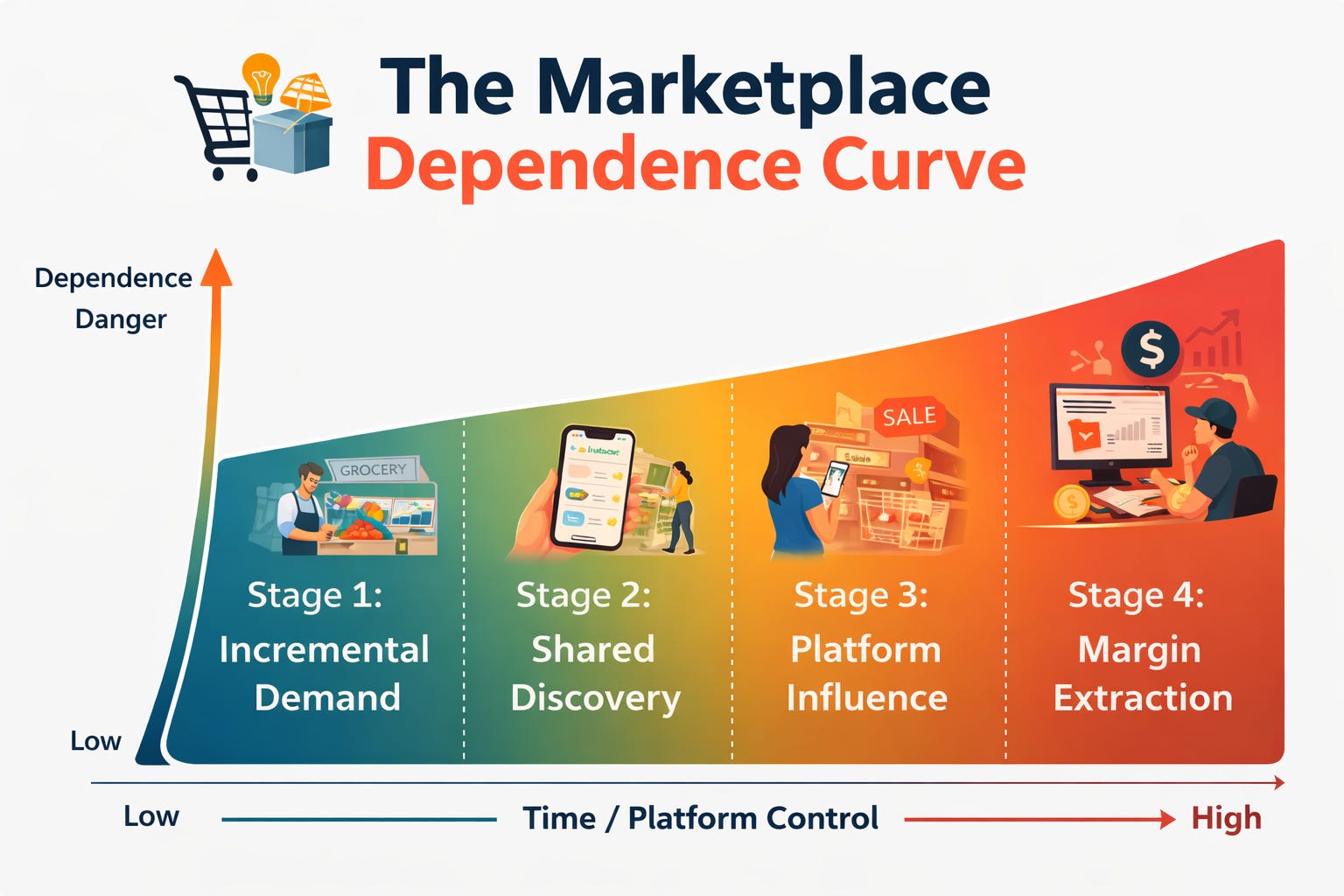
What they’re actually doing is moving along a dependence curve.
⚠️Stage 1: Incremental Demand
Marketplace orders show up as new revenue. Digital penetration ticks up. The board deck looks good. Leadership calls it growth, and honestly, at first it often is.
But something has already quietly shifted. Discovery is no longer happening inside the grocer’s ecosystem. It’s happening inside someone else’s interface. For a mid-tier chain without the brand gravity to pull customers directly, that’s a more dangerous concession than it looks.
⚠️Stage 2: Shared Discovery
Customers stop choosing a store first. They open Instacart, browse what’s nearby, and then decide where to shop.
For a regional grocer, this is where the differentiation problem starts compounding. You’re now sitting in a list next to Kroger, Albertsons, and a dozen other options, ranked by an algorithm you don’t control. The customer still thinks of you as their store. The platform is already treating you as a commodity. And once that gap opens, the platform starts filling it.
⚠️Stage 3: Platform Influence
Now the marketplace is directly shaping the economics. Which products surface first? Which promotions get visibility? How do substitutes get suggested when something’s out of stock?
Mid-tier grocers are especially exposed here. They rarely have the negotiating leverage to push back on placement decisions, and they don’t have the owned data infrastructure to see what’s actually happening to their margins at the basket level. They’re flying blind inside someone else’s system.
⚠️Stage 4: Margin Extraction
The platform controls discovery, sponsored placement, advertising revenue, and behavioral data.
The grocer is still doing the fulfillment, paying the labor costs, holding the inventory risk. But they’re competing for visibility inside an ecosystem they don’t own, and the platform is monetizing the traffic they helped generate. For a mid-tier operator already running on thin margins, this isn’t a slow bleed. It’s a structural problem.
The economics are clearer than most people think. Instacart typically takes 6-7% of the gross transaction value (GTV)1 . On top of that, the grocer loses the retail media revenue they would have captured if the same order had come through their own channel, usually an additional 2-5% of the basket value2 . Add it together and the combined drag versus a first-party order runs 8-12% of gross merchandise value (GMV), before labor and fulfillment costs even enter the picture.
For a grocer operating at 1-3% net margins3, that math doesn’t leave much room. They’re not just paying a commission. They’re surrendering the ad dollars, the data, and the customer relationship all at once, while still absorbing the operational cost of getting the order out the door. That’s the difference between building a profitable digital channel and quietly subsidizing someone else’s platform.
Here’s the uncomfortable part.
Most mid-tier grocery executives believe they’re sitting somewhere in Stage 1 or early Stage 2. A useful partnership, manageable dependency, good incremental volume.
A lot of them are already in Stage 3. And they don’t have the scale, the data, or the brand loyalty to easily pull customers back once the platform becomes the default starting point.
The transition to Stage 4 doesn’t announce itself. By the time the economics become undeniable, the customer habits are locked in. And habits are a lot easier to form than to break.
What to do about it:
🗺️ Start by figuring out where you actually are on the curve.
If you don't have a first-party app or site, that's your answer: every digital order you fulfill is building someone else's customer relationship. If you do, pull the numbers. What share of digital volume comes through your own properties versus a marketplace? Is your repeat purchase rate growing or eroding? Not knowing is already diagnostic.
📱 Treat your first-party app like a product, not a checkbox.
If you don't have an app at all, this is your starting line, not a disadvantage you can't recover from. If you do, be honest about whether it's actually earning opens. Most mid-tier grocer apps exist mainly to say they have one. Slow, weak personalization, no real reason to choose it over Instacart. You don't need to out-engineer them. You just need to be good enough that your loyal customers prefer coming directly to you.
🏡 Use your local advantages.
Mid-tier grocers have something national platforms can’t replicate. Local produce relationships, regional brands, staff who know regulars by name. None of that shows up in a marketplace feed ranked by delivery speed. But it can anchor a first-party experience that customers genuinely prefer. Lean into it as strategy, not nostalgia.
The bar is lower than most assume. You’re not trying to beat Instacart at convenience. You’re trying to give your best customers one compelling reason to start with you. A local assortment they can’t find elsewhere. A deal exclusive to your app. Pick one, own it. One strong hook beats a dozen generic features every time.
🤝 Structure the marketplace relationship with guardrails.
Marketplaces don’t have to be a blank check. Some grocers are getting smarter about which categories they allow on third-party platforms, how they handle substitutions, and whether they share promotional pricing that trains customers to expect discounts they’ll never see on a first-party channel. You probably can’t renegotiate everything overnight. But you can stop making concessions that accelerate the dependency without getting anything structural in return.
None of this is fast. And none of it is free. But the alternative is drifting quietly into Stage 4, where the economics are obvious and the options are narrow.
The goal isn’t ditching the marketplace. These platforms can still move real volume. But the moment they become the default starting point, the game changes.
First-party customer relationships aren’t a nice-to-have for a grocer that can’t out-spend Kroger or out-experience Whole Foods. They’re the whole game.
Lose the starting point and you’re not a destination anymore. You’re just a fulfillment node someone else is renting.
The Marketplace Trap is a 10-part series on why mid-tier grocers are handing customer ownership to platforms, and what they can do to take it back.
The full series:
“Instacart Form S-1 Registration Statement, 2023." U.S. Securities and Exchange Commission: https://www.sec.gov/Archives/edgar/data/1579091/000119312523231909/d55348ds1a.htm
“Retail Media: The $10 Billion Opportunity.” Bain & Company: https://www.bain.com/insights/retail-media-the-10-billion-opportunity
“Grocery industry profit margins fall to pre-pandemic levels: FMI.” Grocery Dive: https://www.grocerydive.com/news/grocery-industry-profit-margins-fall-to-pre-pandemic-levels-fmi/720517