



This is the seventh post of a 10-part series: AI Reality Check for Grocers. Here’s the first post to catch up.
The AI your vendor is selling you won’t save your margin. The AI nobody’s demoing might.
Smarter search. Dynamic pricing. Personalized offers. Checkout-free stores. The demos are impressive, and the conference keynotes are full of them. But mid-tier grocers chasing that playbook are wasting capital to fight a war they’ve already lost.
Walmart and Amazon will always outspend them on the front end. Always. The only place a grocer can actually win with AI is somewhere nobody’s making a keynote about: the back of the store.
The Pyramid, Revisited
The Grocery AI Pyramid breaks AI investment into three layers:
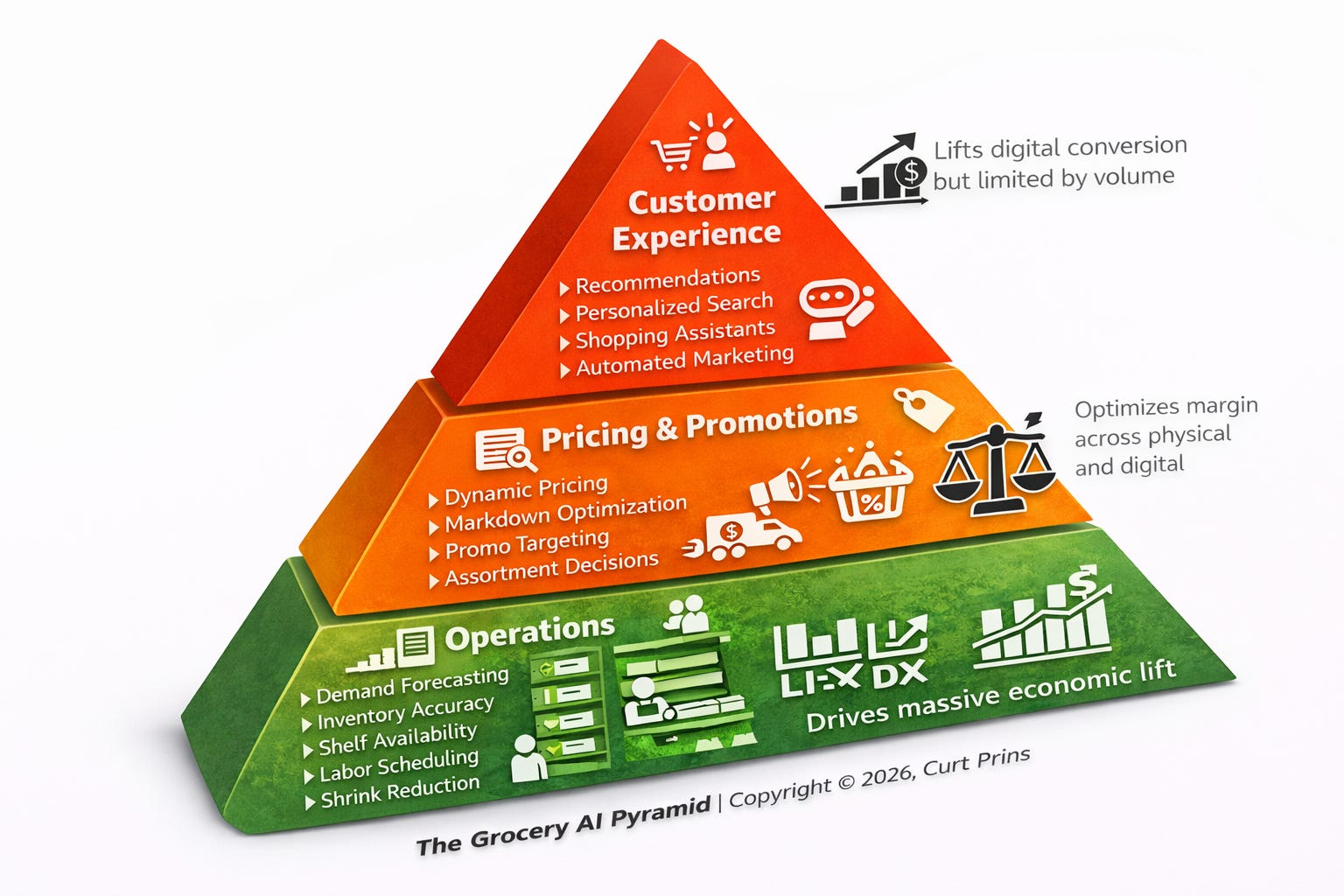
🟥At the top: the sexy stuff. Generative UI, personalized recommendations, and AI-powered search. This is where the press releases live. It’s also where the ROI for a 40-store regional chain goes to die.
🟧The middle layer: category intelligence. Retail media optimization, dynamic promotions, and demand sensing. Useful, but still largely customer-facing. Still dependent on clean foundational data underneath.
🟩And the bottom: operational plumbing. Demand forecasting. Inventory precision. Labor scheduling. Fresh ordering. Shrink reduction. The stuff that isn’t photogenic but is the actual difference between solvency and a bankruptcy filing in a 1-3% margin business.
In 2023, grocery industry profit margins hit 1.6%, the lowest level since 2019, as total expenses rose across the board1. That’s not a number that leaves room for experimental consumer-facing technology that might improve cart conversion by 4%. That’s a number that demands you fix the foundation or start looking for an exit.
The Pyramid Flip isn’t a brand strategy. It’s triage.
The Margin of Survival
Here’s the math that should keep regional grocery CEOs up at night.
A store with $5 million in annual revenue retains between $50,000 and $150,000 in profit2 after all costs. At that margin, a 1% improvement in shrink or labor efficiency isn’t a nice-to-have. It’s survival math.
Shrink rose in fiscal 2023 for independent grocers, with the worst losses concentrated in floral, bakery, produce, and deli3. Those aren’t random categories. They’re the exact departments where AI-driven forecasting and fresh ordering tools have the clearest ROI case. They’re also the departments where most mid-tier operators are still guessing.
The technology exists to close this gap right now.
A leading regional supermarket chain reduced fresh item spoilage by 20% through intelligent replenishment systems. Separately, an online grocer specializing in fresh foods achieved a 49% reduction in food waste after implementing AI-driven demand forecasting4. Kroger, using tools from Shelf Engine and Afresh to manage fresh inventory, saw roughly a 25% drop in food waste5.
For a regional operator losing $400,000 a year to fresh shrink, a 20-25% improvement is $80,000 to $100,000 back on the table. Before you touch labor. Before you touch scheduling. Just from ordering fresh more intelligently.
Front End vs. Foundation: The Real Question
Here’s what the platforms want you to believe: that outsourcing your consumer-facing AI to Instacart or DoorDash is a reasonable shortcut. Let them handle search, discovery, and fulfillment. You focus on the store.
It isn’t a shortcut. It’s a trap.
Every order fulfilled through a marketplace is a data point you don’t own. Every search query answered by Instacart’s algorithm is customer intent intelligence that lives on their servers, not yours. You’re not renting a storefront. You’re slowly transferring the customer relationship, and the operational intelligence that comes with it, to a platform that competes with you for that customer’s next order.
But here’s the part that makes it worse: if your back-end data is a mess, you can’t exit even if you want to. You become dependent not because the platform is indispensable, but because your own operational foundation is too weak to stand on. Bad inventory data, manual fresh ordering, and no real-time shelf visibility.
That's not a technology problem. That's a hostage situation. And the platforms know it.
One European grocer lifted revenue by 2% in six months by combining fixed cameras and mobile devices to improve on-shelf availability. Out-of-stocks were fixed before customers noticed6. That’s what operational sovereignty actually looks like. Fix the foundation, and the platform dependency becomes a choice rather than a necessity.
The grocers who will be standing in ten years are the ones who own their inventory data at the item level, know their cost per unit of shrink in each department, and have AI-driven replenishment running in fresh before they spend a dollar on personalization.
Here's what that looks like in practice, against what most vendors are actually selling you:
Foundation vs. Facade: Where AI Investment Actually Pays
The Bottom Line
Walmart spent $14 billion on technology in fiscal 2024. Amazon built its own fulfillment network from scratch. You are not going to out-innovate them on the customer experience layer with a $2 million budget and a 40-store footprint. That’s not a knock. It’s just physics.
The good news is you don’t have to. The foundation layer is where regional grocers actually have an advantage: operational agility, faster decisions, less bureaucracy. A 40-store chain can stand up AI-driven fresh ordering in 90 days. A 2,000-store national chain takes two years and three change management consultants to do the same thing.
Own your inventory data. Fix your fresh ordering. Know your shrink numbers cold. That’s not innovation. It’s industrial hygiene.
The grocers who figure this out first won't be talking about it at conferences. They'll just be the ones still open.
In Part 2, we cover the labor angle, where the real operational leverage lies. The short version: AI scheduling isn't about cutting headcount. It's about giving your best people their time back.
AI Reality Check for Grocers is a 10-part series that cuts through the hype and focuses on where AI actually creates value, from the shelf to the supply chain.
“Grocery industry profit margins fall to pre-pandemic levels: FMI.” Grocery Dive: https://www.grocerydive.com/news/grocery-industry-profit-margins-fall-to-pre-pandemic-levels-fmi/720517
“How Much Do Grocery Stores Make? (Average Grocery Store Revenue Data 2025).” Toast Blog: https://pos.toasttab.com/blog/on-the-line/how-much-do-grocery-stores-make
“2024 Independent Grocers Financial Survey.” National Grocers Association: https://www.nationalgrocers.org/news/2024-independent-grocers-financial-survey-webinar-key-takeaways
“AI May Slash Food Waste 49%.” Trax: https://www.traxtech.com/ai-in-supply-chain/ai-may-slash-food-waste-49
“How AI is Transforming Food Supply Chains.” The Food Institute: https://foodinstitute.com/focus/how-ai-is-transforming-food-supply-chains
“How AI is Transforming Food Supply Chains.” The Food Institute: https://foodinstitute.com/focus/how-ai-is-transforming-food-supply-chains