


TL;DR
Walmart insists its electronic shelf labels are paper tags with batteries, yet it touts Sparky's bigger baskets to investors while downplaying them to critics, and it never explained why it patented cart-based pricing it swears it won't use. The space between customer tracking and surveillance pricing is narrow, since the app, its AI shopping assistant Sparky, and the shelf tag share one pipe held apart only by a rewritable policy. ESLs are promising technology, but with trust polling low and states passing bans, they carry too much baggage for most grocers right now.
Walmart owns a 2023 patent describing a shelf price for mayonnaise that changes when a shopper already has tuna in her cart.1 On October 5, Dan Bartlett, the company’s head of corporate affairs, published an open letter swearing Walmart doesn’t do that and never will.2 When Retail Dive asked why Walmart would patent a pricing method it promises never to use,3 Walmart didn't respond.
That silence sits at the center of a two-week campaign to defend electronic shelf labels (ESLs). The campaign included a CEO letter,4 a corporate blog post with a Q&A,5 a new in-store navigation feature, and Bartlett’s public rebuke addressed by name to Lindsay Owens, who runs the consumer advocacy group Groundwork Collaborative.6
I read it all, and I came away more convinced that most grocers should leave ESLs on the vendor’s demo cart for now. If the world’s largest retailer fumbles the message, this technology is too hot to adopt.
Two terms get blurred in this fight, so here’s how I use them. Dynamic pricing moves a price for everyone based on demand, like soup costing more when a snowstorm hits. Surveillance pricing moves a price for one person based on what a company knows about them, like that mayonnaise.
What Walmart is saying
Walmart deserves a fair hearing first. John Furner’s late-September letter promised that a shopper’s income, shopping history, urgency, or willingness to pay will never move a price. Bartlett's follow-up went further and described the tags as a paper replacement that displays prices already approved through a central process.
Bartlett’s letter argued that Owens blurred the line between what a technology could do and what Walmart does with it.
The operations case holds up. According to Supermarket News, the LEDs built into Walmart’s tags already power Stock to Light, which shows associates where product belongs, and Pick to Light, which guides online order pickers to the right facing.7 Anyone who has watched an overnight crew chase a few thousand paper tags with a scanner and a stack of printouts knows why a chain would want that job gone.
Furner also pointed out that labels help ensure the shelf price matches what rings up at checkout. Price-accuracy complaints wreck trust faster than most promotions build it, so that benefit counts.
ESLs are promising technology. They cut labor on price changes, keep the shelf in sync with the register, and turn every facing into a small wayfinding beacon. I’d want them in any store I ran if consumer mistrust weren’t part of the price.
The week the story split
The patent is the cleanest contradiction. Retail Dive reported that Walmart received it in 2023 for remotely controlling electronic shelf labels.8 The filing describes adjusting prices based on what’s already in a shopper’s cart and on supply and demand, and its own example says a customer with tuna “may be offered a different price for mayonnaise.”
Bartlett argued that a patent only describes what an invention could do. That argument would land better if Walmart had answered the one reporter who asked why it filed the patent in the first place.
Walmart is talking out of both sides of its mouth. It holds a patent for cart-based shelf pricing and a letter swearing it will never use one, and it won't explain the gap.
Shop to Light stretches the story a second way. Walmart launched the feature on October 1, and it lets shoppers use the app to make a specific shelf tag blink so they can find an item. Four days later, Bartlett's letter described the same tags as paper replacements that identify no one and decide nothing on their own.
Nothing in the coverage says Shop to Light identifies anyone, and I’m not claiming it does. What worries me is capability creep, since a tag that started as a price display now takes requests from a customer’s phone.
The paper-tag defense works only as long as the tag keeps acting like paper, and every new feature pulls it further from that description.
How short the distance is
I’ve built shopper apps for a living, and this is what bothers me. The space between customer tracking and surveillance pricing is narrow. The display and the pricing engine share one pipe, and the only thing separating them is a rule some developer or bot can rewrite.

Look at what flows through that pipe. Walmart's app and Sparky, its AI shopping assistant, take in what shoppers ask for and, by Walmart’s own account, sometimes how urgently they need it. The shelf tag shows whatever price the central system sends, and Walmart’s Q&A says approved price changes are “typically made outside of shopping hours.”
Typically is a word lawyers love. The reach keeps growing too, because Walmart bought Vizio in 2024, and Walmart U.S. CEO David Guggina told a Goldman Sachs audience he could picture Sparky on the TVs customers keep for about seven years.9
Bartlett’s letter makes one argument over and over: capability doesn’t equal practice. I accept the logic. The letter concedes the key point in making it, though, because nobody spends a page separating capability from practice unless the capability is real.
What separates Walmart’s stack from surveillance pricing today is a policy. Policies live in CEO letters, and CEO letters get rewritten when leadership changes or margins tighten.
Why perception always wins
ESLs carry too much negative perception to be a smart adoption for most grocers right now. Shoppers already distrust them. A GBAO Strategies poll commissioned by UFCW and RWDSU locals found that two-thirds of New York voters support banning the tags in grocery stores, and 66% say they don’t trust grocers to use the technology responsibly.10
Grocery unions have their own stake in labor-saving tech, so weigh the source. The fear still runs far ahead of the evidence, because a study covered by the AP looked at one chain’s prices from 2019 to 2024 and found that temporary price increases barely moved after it installed digital labels.11
That gap between what ESLs do and what shoppers believe they do makes them a bad bet right now.
Lawmakers have already acted on that belief. Maryland’s law barring grocers from using digital labels to change food prices during the day took effect October 1, Seattle banned personal-data grocery pricing in September, and New Jersey and Connecticut passed similar measures. New Jersey also imposed a one-year moratorium on installing digital labels altogether.
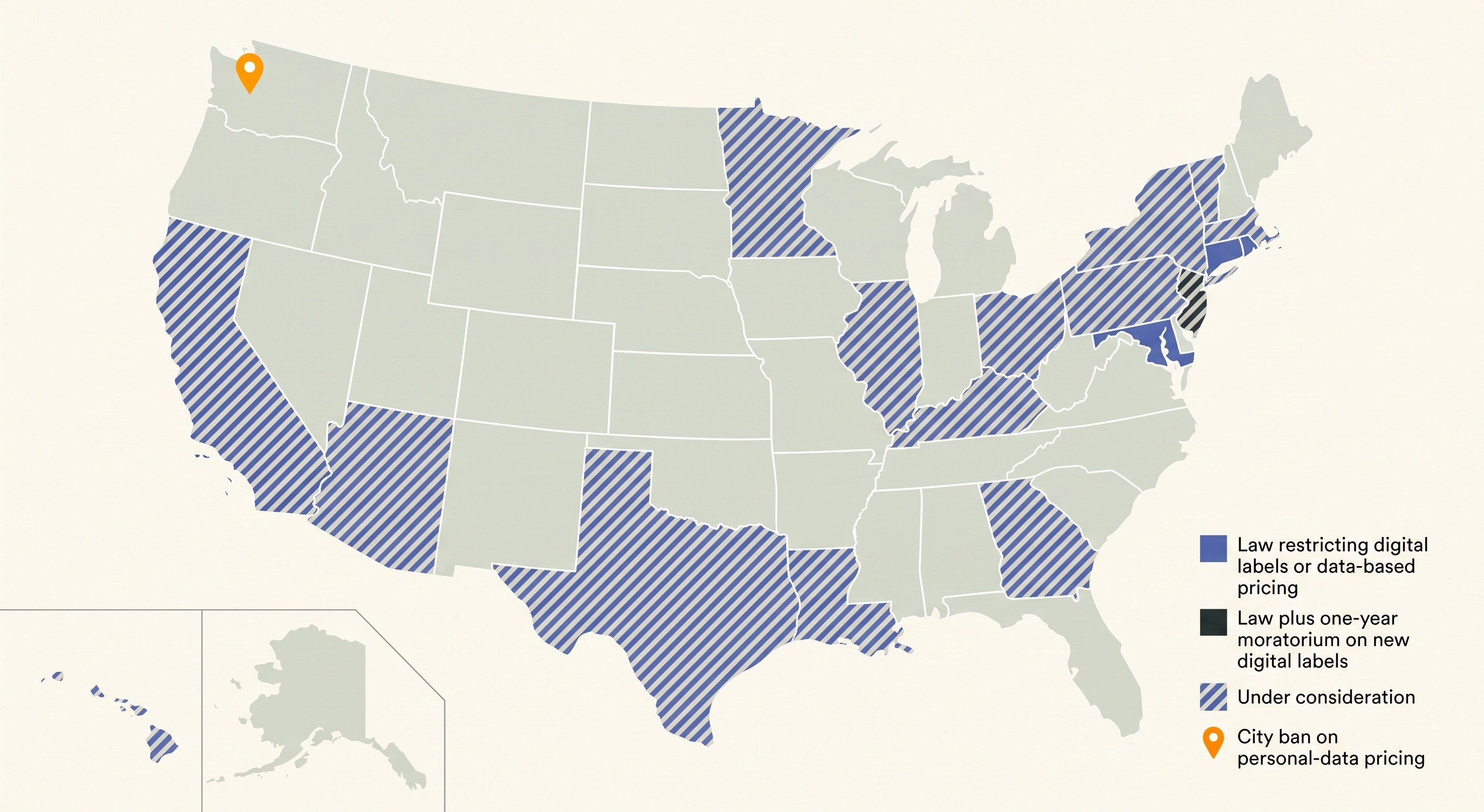
A moratorium means a regulator decided the hardware itself became the problem. Walmart can absorb that fight with a corporate affairs chief and an FAQ. Any regional chain in New Jersey with ESLs on its roadmap just lost a year and picked up a public relations problem it didn’t create. Many other states have legislative bills under review.
The exposure spreads past Walmart. Supermarket News lists Hy-Vee, Kroger, Whole Foods, Sprouts, and Save Mart among the grocers rolling out digital labels.12 Each one inherits Owens’s picture of pricier ice cream on hot days.
Shoppers don’t choose grocers by who wrote the better letter.
The fight grocers keep picking
I wrote about this pattern when Maryland lawmakers first went after dynamic grocery pricing. I argued that operators pointed their technology at capturing margin from customers when they could have captured it from reducing operational waste.
ESLs repeat that mistake in public view. A shrink model runs in a back office no shopper ever sees, while a digital price tag hangs at eye level in every aisle. Stock to Light and Pick to Light point the tags at labor and accuracy, and Shop to Light, the one piece aimed at shoppers, is where Walmart’s story started to stretch.
A mid-tier chain can chase part of the same savings this year without hanging anything in front of a shopper. They can implement better handheld workflows for price changes, tighter shelf-to-register audits, and forecasting that cuts markdowns that run out of sight.
Bartlett closed his letter by asking Owens to correct the record. Owens had already asked Walmart to pull the patent filings.
Are ESLs worth the drama attached to them?
“US11687872B2: System and method for remote controlling of electronic shelf labels.” Google Patent Search: https://patents.google.com/patent/US11687872B2/en
“Correcting the Record: We Price Products, Not People.” Walmart Corporate Affairs: https://corporate.walmart.com/news/2026/10/correcting-the-record
“Walmart CEO addresses dynamic pricing concerns.” Grocery Dive: https://www.retaildive.com/news/walmart-ceo-dynamic-pricing-concerns/831490/
“A Letter from Our CEO.” Walmart Corporate Affairs: https://corporate.walmart.com/about/everyday-affordability/letter-from-our-ceo
“The Facts on Affordability.” Walmart Corporate Affairs: https://corporate.walmart.com/about/everyday-affordability/the-facts-on-affordability
“Groundwork’s Lindsay Owens’ New Corporate Pricing Exposé Already Landing Blows, Forcing Walmart to Do Cleanup.” Groundwork Collaborative: https://groundworkcollaborative.org/news/groundworks-lindsay-owens-new-corporate-pricing-expose-already-landing-blows-forcing-walmart-to-do-cleanup/
“Walmart activates shelf lights for shopper navigation.” Supermarket News: https://www.supermarketnews.com/grocery-technology/walmart-activates-shelf-lights-for-shopper-navigation
“Walmart CEO addresses dynamic pricing concerns.” Grocery Dive: https://www.retaildive.com/news/walmart-ceo-dynamic-pricing-concerns/831490/
“Walmart Inc. (WMT) Presents at Goldman Sachs Global Consumer and Retail Conference Transcript.” Seeking Alpha: https://seekingalpha.com/article/4947846-walmart-inc-wmt-presents-at-goldman-sachs-global-consumer-and-retail-conference-transcript
“Poll: New Yorkers Want Full Ban on Digital Tags as Maryland Passes Landmark Surveillance Pricing Law.” The Packer: https://www.thepacker.com/news/retail/poll-new-yorkers-want-full-ban-digital-tags-maryland-passes-landmark-surveillance-pri
“Shoppers are wary of digital shelf labels, but a study found they don’t lead to price surges.” Bar Chart: https://www.barchart.com/story/news/32778259/shoppers-are-wary-of-digital-shelf-labels-but-a-study-found-they-don-t-lead-to-price-surges
“Walmart activates shelf lights for shopper navigation.” Supermarket News: https://www.supermarketnews.com/grocery-technology/walmart-activates-shelf-lights-for-shopper-navigation