


This is the fourth post of a 10-part series: AI Reality Check for Grocers. Here’s where we started.
Grocers treat inventory accuracy like a technology problem. The technology isn’t the problem.
Gartner estimates store-level inventory accuracy can fall as low as 60%. IHL Group reports that only 1 in 4 US retailers meets basic shelf accuracy standards1. Most operators know this. What they don’t always see is the loop that keeps it there.
Here’s how it plays out.
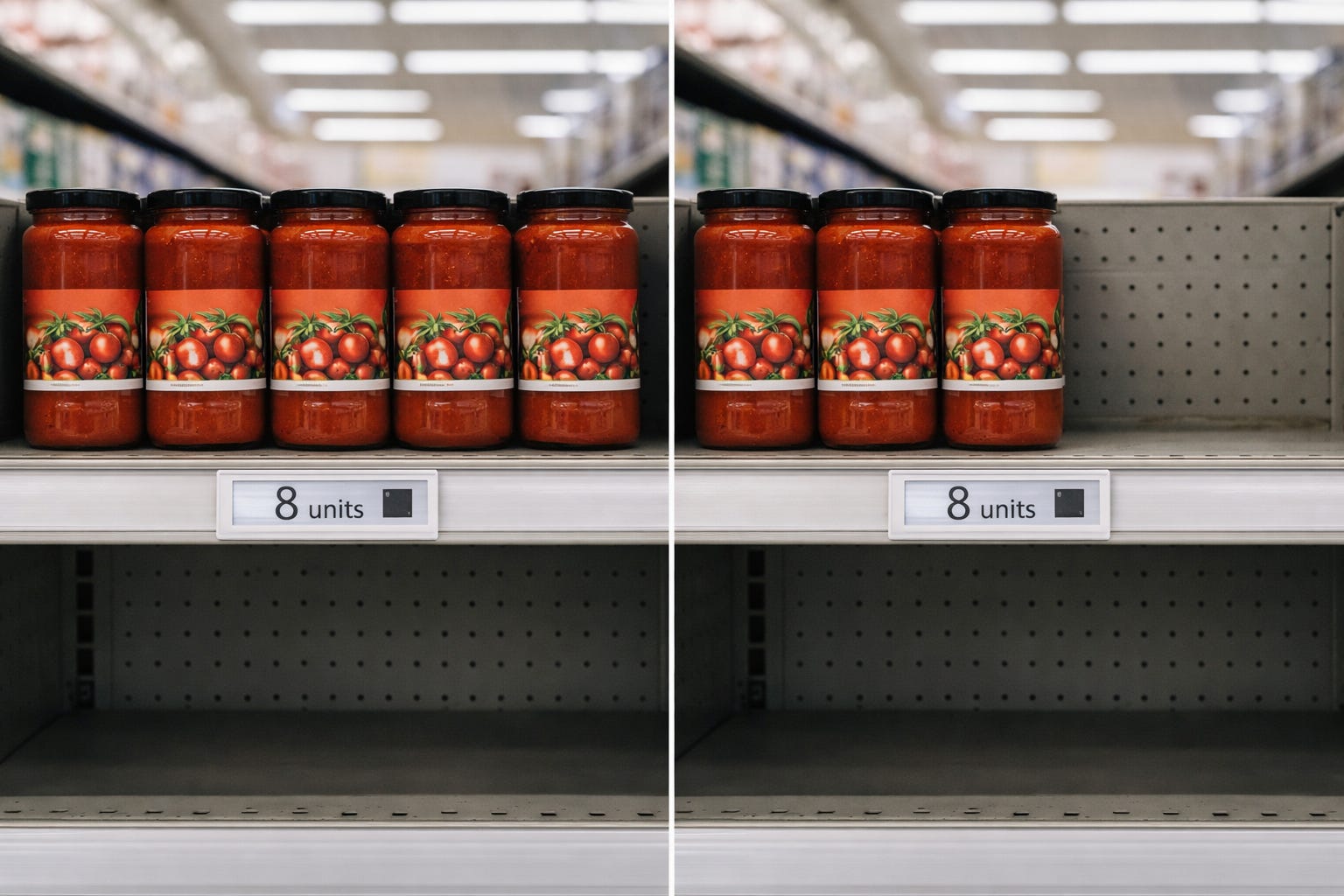
A receiver logs an inbound shipment. It’s busy, the truck is running late, and the count gets done fast. A few units get miscounted. Nobody flags it because the discrepancy is small and there are twelve other things to do. Later that week, a store associate is walking down the dairy aisle and sees three units of an item on the shelf. The system says eight. She’s seen this before. She knows the system is off. So she manually bumps the reorder quantity and moves on.
That decision is completely rational. She’s done it a hundred times. The system has been wrong a hundred times. She’s working around a tool she doesn't trust.
But here’s what just happened: that override didn't get logged. The gap widened. Shrink happens and goes unrecorded. It gets wider. A return gets processed incorrectly at checkout. It’s wider again.
Discrepancies erode trust. And once that trust is gone, the workarounds multiply. People stop relying on the system for ordering decisions. They carry mental buffers and over-order to compensate.
That compensation introduces new errors. The data gets worse. Repeat.
🔁This is the loop. And it doesn’t live in the software. It lives in the gap between what the system shows and what people actually see when they walk the floor.
AI doesn’t break this loop. It amplifies it.
Feed a machine learning model inventory data that’s 75% accurate and you get very confident, very fast predictions that are wrong in the same ways the original data was wrong. A model trained on bad data doesn't know it's wrong. It will optimize against phantom inventory, products the system thinks exist but don't, with the same confidence it would bring to clean data.
Garbage in, garbage out has always been true. It’s just faster and more expensive now.
That’s not a technology adoption problem. It’s a sequencing problem. You can’t layer intelligence on top of a data foundation that store teams have already stopped trusting.
So what does fixing it actually look like? Four places to start.
Treat shrink as data, not just cost. Most US grocers track shrink as a line item. Fewer treat it as a signal. Where is it happening? Which categories? Which stores? Which shifts? Shrink that gets categorized and analyzed tells you exactly where your inventory data is leaking. Shrink that just gets absorbed tells you nothing.
Fix receiving first. Most inventory errors enter the system at the dock. Inbound counts done under time pressure, vendor substitutions that don’t get logged, and damaged goods absorbed into shrink instead of flagged as receiving exceptions. Tighten this process before anything else. It’s the front door of your data quality.
Make reporting discrepancies easier than ignoring them. If flagging a count error takes four steps and a manager’s approval, people won’t do it. They’ll adjust manually and move on. The path of least resistance must be the correct path. That’s a UX problem, not a technology problem.
Run a cycle count program that store teams actually believe in. Accuracy starts to deteriorate the moment a count is taken. The goal isn't a dashboard score. It's rebuilding the habit of believing the system.
Half of US retailers are losing sales right now because of this problem2. Fix the data foundation, and that’s revenue sitting right there waiting to be recovered. But it only shows up if you do the operational work first.
None of that is glamorous. None of it demos well in a vendor pitch. There’s no dashboard that says “we rebuilt our team’s trust in the system.” No press release goes out when you fix your receiving reconciliation process.
The grocers who figure this out first won't announce it. They'll just quietly start winning.
AI Reality Check for Grocers is a 10-part series that cuts through the hype and focuses on where AI actually creates value, from the shelf to the supply chain.
“How inventory accuracy and on-shelf alignment kills retail revenue.“ Chain Store Age: https://chainstoreage.com/how-inventory-accuracy-and-shelf-alignment-kills-retail-revenue
“Shelf Intelligence Report: Rebuilding Retail Relationships Through Automation.“ IHL Group: https://www.ihlservices.com/news/analyst-corner/2025/11/ondemand-shelf-intelligence-report-rebuilding-retail-relationships-through-automation