


TL;DR
Instacart and DoorDash want grocers to price online at shelf parity to fix delivery affordability, which asks a 2.1% margin business to eat the commissions while the platforms' fees stay put. Grocers deliver through their own apps, often without an item markup or delivery fee, so the affordability problem is the marketplaces, not delivery. It's marketplace misdirection, and it's Stage 4 of the Marketplace Dependence Curve announcing itself.
Rents in my city rose more than 25% last year, the steepest climb in the country. A one-bedroom in San Francisco now goes for $4,000 a month. The reason is not a mystery: AI hiring pulled high earners back into the city, and the people collecting the rent call it supply and demand.
This month at Groceryshop in Las Vegas, two companies headquartered here told a room of grocery executives that online grocery has become unaffordable and that grocery pricing is the reason.
Same industry, same move, different bill.
The diagnosis was right. The prescription was not.
Instacart CEO Chris Rogers told the Groceryshop audience that affordability is the number one reason shoppers churn off online grocery and the biggest barrier to adoption.1 Every operator in that room already knew it.
Then he named the remedy. Instacart is lobbying the grocers it works with to price online at shelf parity, or only slightly above. Rogers acknowledged those conversations have been difficult, and Instacart says 90% of U.S. shoppers now have access to a parity grocer on its platform.2
DoorDash is pressing the same point. Its VP of grocery and retail partnerships confirmed the company continues to push parity with its grocer partners.3
Look at who is being asked to sacrifice
FMI puts average net profit for grocers at 2.1% and noted that roughly 11% of grocers posted operating losses.4
That is two cents on the dollar, and it is the business is also being asked to solve affordability through price concessions.
Now look at the other side of the table. Both Instacart and DoorDash layer a service fee, a delivery fee, a tip, and often a subscription on top of item prices that grocers mark up above the shelf. That markup mostly covers the commissions Instacart and DoorDash charge grocers, which in my experience run 5 to 10 times a grocer's net margin, and parity asks grocers to absorb them instead.
Last December, a Consumer Reports and Groundwork Collaborative investigation also found identical items priced as much as 23% apart from one Instacart shopper to the next.56
Instacart’s position in Washington makes the point for me. When the FTC opened a rulemaking in April on fee practices in food and grocery delivery, Instacart opposed all-in pricing, arguing it would make individual grocery items look confusingly expensive.7 In Washington, showing shoppers the full cost is confusing, and in Las Vegas, the grocer’s shelf price is the problem.
Neither company proposed changing anything. Cutting that fee stack is the fastest fix for delivery affordability, and it belongs to the two companies that spent Groceryshop pointing at grocers.
The number that ends the argument
Order through a grocer’s own site or app and the cost structure changes completely.
First-party delivery carries real expense in picking labor, packaging, routing, and shrink on substitutions. Grocers typically recover it with a modest item markup or delivery fee. The total still comes to a fraction of what the same basket costs on a marketplace once the item markup, service fees, delivery fees, and tips stack up.
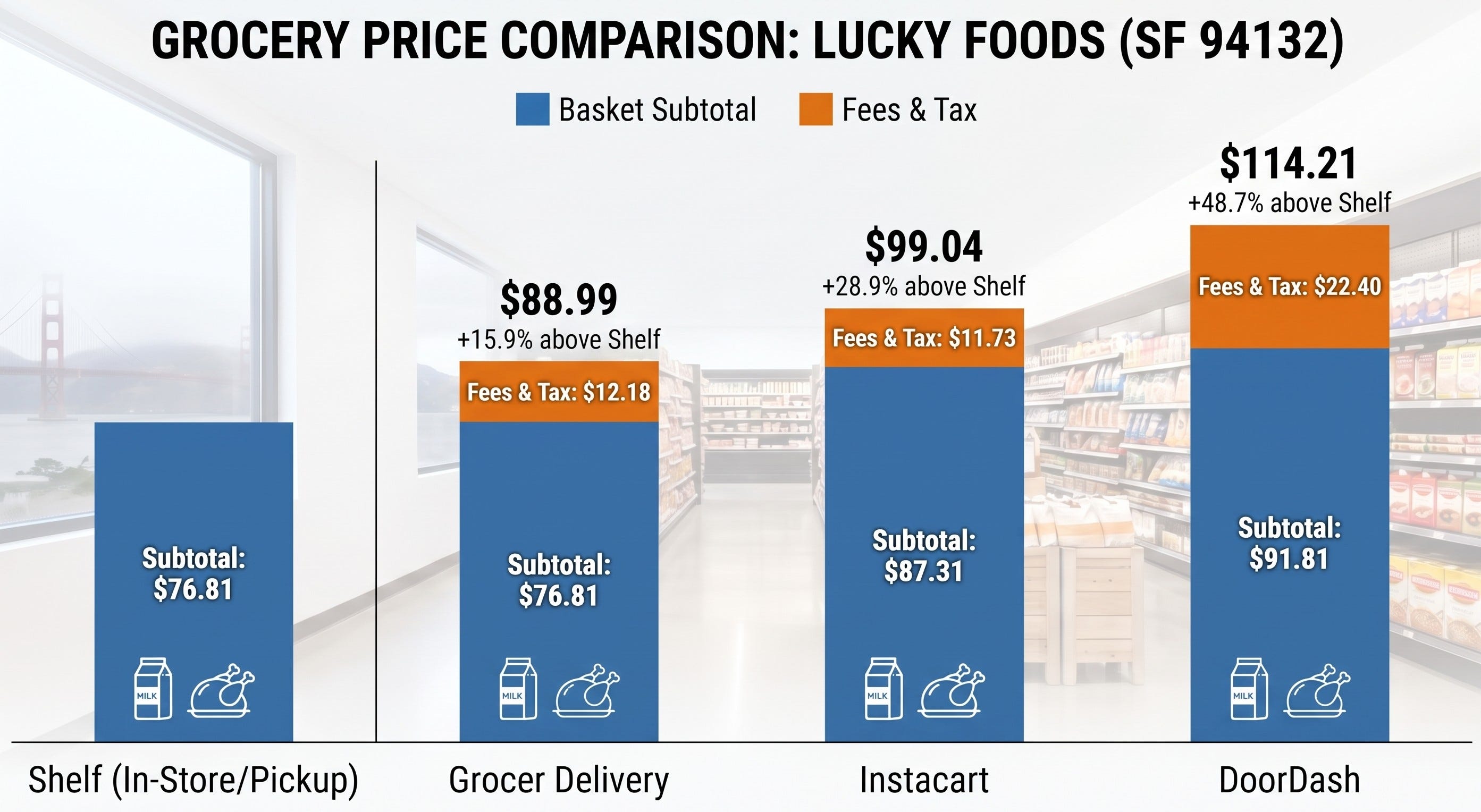
It is the same store with the same shelves, and frequently the same pickers. The only difference is how many parties take a cut.8
Delivery did not make online grocery unaffordable. The marketplaces did. That sentence went unsaid at Groceryshop. Pointing the crisis at the grocer's shelf price is marketplace misdirection, and the trade coverage since has mostly transcribed the keynotes.
Stage 4 announced itself
I created The Marketplace Dependence Curve months ago to warn grocers about this risk of overreliance. Like an addiction, this curve runs through four stages: incremental demand, shared discovery, platform influence, and margin extraction. My argument was that most mid-tier operators believe they sit in Stage 1 while already in Stage 3, and that Stage 4 arrives quietly.
Grocers stay because a growing share of their online shoppers already order there, and walking away hands those shoppers to a competitor in the same app.
This time Stage 4 showed up on a main stage.
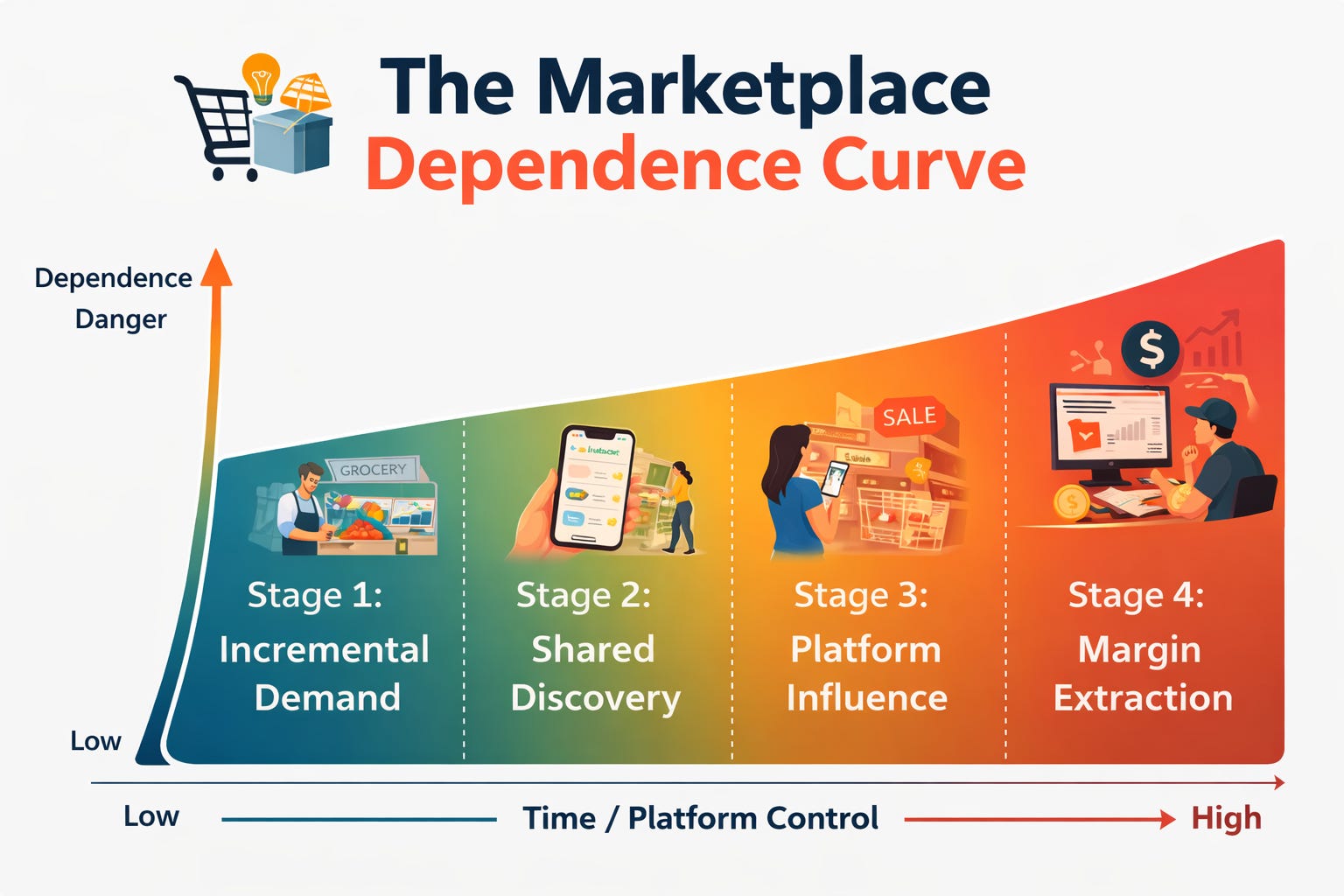
Margin extraction is what happens once a platform controls enough demand to dictate the grocer’s economics. A public campaign to set your online shelf price, already reaching 90% of U.S. shoppers, is not a negotiation between partners.
Instacart’s defense is that parity grocers have grown more than 10 percentage points faster on its platform and retain customers better.9 Read through the curve: faster growth inside someone else’s interface, with discovery, data, and the customer relationship on their side, is the exact mechanism that carries an operator from Stage 2 to Stage 4.
They described the dependency and sold it as a feature.
I made the case for why that growth belongs to Instacart, not the grocer, in The Instacart Search Question.
An analyst asked DoorDash’s CEO Tony Xu on their Q2 2026 earnings call whether the company could reprice grocer relationships and shift some of the affordability burden back onto grocers.10 Xu declined to discuss specific economics, but he said that DoorDash might represent 100% of the growth those partners see.
That is not how a partner talks. That is how a landlord talks.
Same playbook, different asset
I call this marketplace misdirection. Build a position between customers and something they need, then price against that position. When the cost turns politically untenable, announce the crisis, express concern, and recommend that somebody else absorb it.
In housing, the somebody else is the tenant. In grocery, it is a business earning two cents on the dollar.
What operators should do with it
Reject the framing first. Grocery pricing didn't break delivery affordability, and a 2.1% margin business isn't where the slack lives.
Then run your first-party model again with today’s parity requirement in it, not the model you built before parity. Ask what it costs to serve that same customer through your own app, at a modest markup, with the relationship on your side of the ledger.
Now run the comparison your shoppers can already see. Put your delivered basket against the same basket on the marketplace, including item markup and fees. If your own channel wins on price, and it usually does, that is a marketing campaign you have not run yet.
The two companies built the most expensive layer in online grocery, then took the stage to explain that the problem is your shelf price. You are being asked to fund a discount on a basket you no longer own, by the same companies whose commissions and fees created the crisis.
Decline.
“Instacart and DoorDash wrestle with online grocery’s growing affordability problem.” Grocery Dive: https://www.grocerydive.com/news/instacart-doordash-tackle-online-grocery-affordability/831246
“5 takeaways from Groceryshop.” Grocery Dive: https://www.grocerydive.com/news/takeaways-groceryshop-conference-2026-las-vegas/831421
“Instacart and DoorDash wrestle with online grocery’s growing affordability problem” Grocery Dive: https://www.grocerydive.com/news/instacart-doordash-tackle-online-grocery-affordability/831246
“FMI report: Grocers double down on technology, health and value as economic pressures persist.” Supermarket News: https://www.supermarketnews.com/grocery-trends-data/fmi-report-grocers-double-down-on-technology-health-and-value-as-economic-pressures-persist.
“Instacart’s AI-Enabled Pricing Experiments May Be Inflating Your Grocery Bill, CR and Groundwork Collaborative Investigation Finds.” Consumer Reports: https://www.consumerreports.org/money/questionable-business-practices/instacart-ai-pricing-experiment-inflating-grocery-bills-a1142182490
“New Report Exposes Instacart’s Hidden Price Games.” Groundwork Collaborative: https://groundworkcollaborative.org/news/new-report-exposes-instacarts-hidden-price-games/
“DoorDash, Instacart face critical FTC fight over consumer fees.” TheStreet: https://www.thestreet.com/restaurants/doordash-instacart-face-critical-ftc-fight-over-consumer-fees
Lucky Food Price Comparison: https://docs.google.com/spreadsheets/d/1yzMjEkIw_VKqR5DfO70ticXHZv_ATn87o0at-Or8mkY/edit?usp=sharing
“The Truth About Pricing Tests on Instacart.” Instacart: https://www.instacart.com/company/updates/the-truth-about-pricing-tests-on-instacart
“DoorDash Q2 2026 earnings call transcript.” Yahoo Finance: https://finance.yahoo.com/quote/DASH.MX/earnings/DASH.MX-Q2-2026-earnings_call-661648.html