


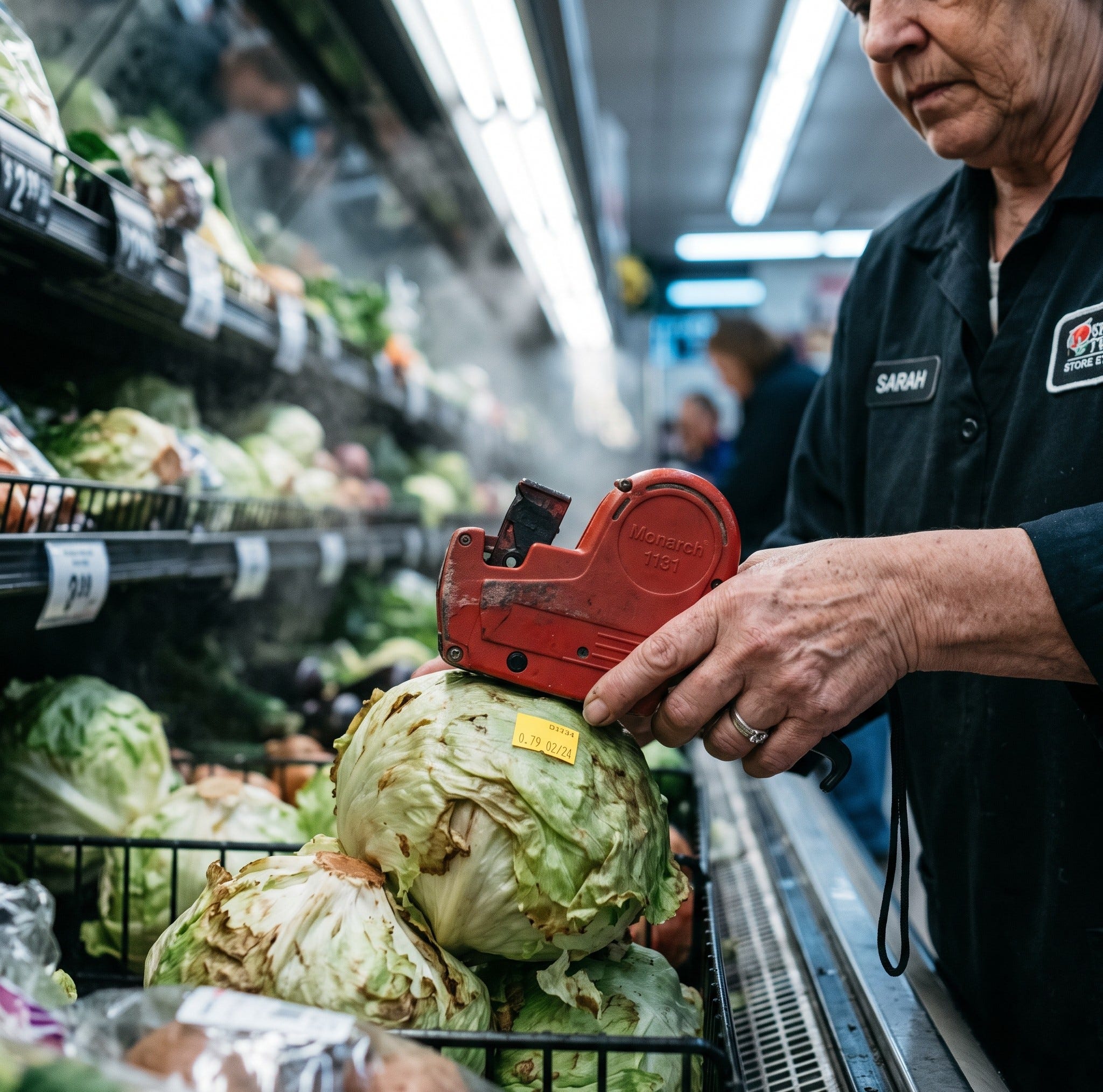
This is the fourth in a 5-part series, You Can’t Prompt Produce, on the AI grocers keep shipping, and most shoppers keep skipping.
TL;DR
Grocery runs on a 1.6% to 2.1% margin. Shrink alone eats 2.7% of revenue. Cut shrink by 100 basis points, and you recover more profit than a best-case customer-facing AI win, by roughly 270x, using five tools no customer ever sees: markdown pricing, shrink detection, demand forecasting, predictive maintenance, micro-fulfillment.
Why are grocers pouring budget into customer-facing AI when shrink alone eats close to their entire profit margin?
That should stop every CFO in the room. It doesn’t, because a personalization demo looks better in a slide deck than a shrink report ever will. I’ve sat through both pitches. Only one gets applause.
The front office mirage
Grocery tech conferences all look the same now. Presentations promote smart carts, AR aisle navigation, and even some concept pitched as “the metaverse of grocery” that nobody in the audience asked for.
Please note: this is NOT an argument against customer-facing AI. It’s definitely needed to secure the next generation of grocery shoppers. A personalization tool that lifts basket size a couple of percent is a real win. I won’t pretend otherwise.
But that lift, for a business running a 1.6% to 2.1%1 net margin, is still small next to what's sitting untouched in operations. The gap comes down to ROI. It's real, just not as dramatic as people make it when they're chasing a headline instead of running the math.
Some of this is pure ego. A CEO announcing an AI shopping concierge gets a stage and a press hit. Nobody claps for “we cut spoilage in the dairy case by 8%,” even though that number shows up in EBITDA every quarter, on time, without a demo.
The grocers who thrive will balance investments in AI that customers can see with the fixes they’ll never notice.
Where the real money sits
The real money sits in parts of the store nobody photographs. The five AI projects below carry more weight than their price tag suggests, and none of them needs a customer to open an app.
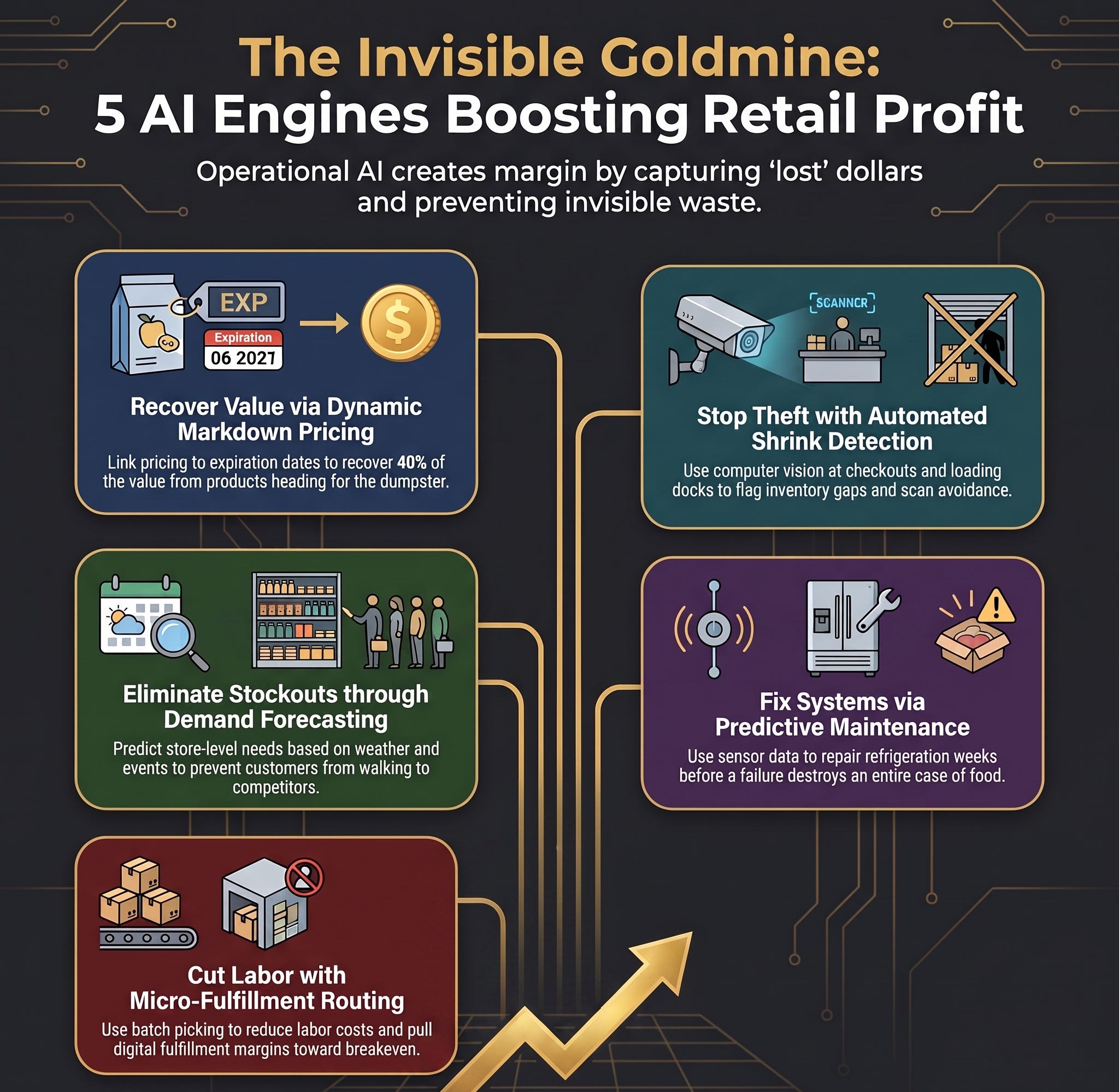
Dynamic Markdown Pricing: Pricing algorithms are tied to SKU-level expiration data to catch a product hours before it becomes a total write-off. Forty cents recovered on a dollar you were about to lose outright is margin with no acquisition cost attached.
Automated Shrink Detection: Shrink prevention runs bigger than most operators say out loud. Computer vision at checkout catches sweethearting and scan avoidance in the moment. Point the same tech at the loading dock, and it flags inventory gaps before finance has to ask what happened. Point it at the produce aisle and less of it ends up in the dumpster.
Demand Forecasting: Predict SKU-level demand down to the store and the day, including weather and local events, then trigger reorders automatically. No marketing campaign will ever do that. Fewer stockouts walk straight to Walmart. Less overordering spoilage rots on the shelf.
Predictive Maintenance: Refrigeration and HVAC get ignored because they're the least glamorous line item in operations, and that gets expensive fast. A compressor failure in a frozen foods case doesn't just cost the repair; it costs everything in that case at once, and the sensor data that would've flagged it three weeks earlier usually just sits there unwatched.
Micro-Fulfillment Routing: Batch picking at the store level cuts labor cost per online order. Digital fulfillment bleeds margin badly right now. This is the one lever actually pulling it toward breakeven.
Running the numbers
Take a $1 billion chain running with a 1.8% net margin. That’s $18 million in profit. Shrink runs 2.7% of revenue on average2, so $27 million is already gone before anyone opens a strategy deck.
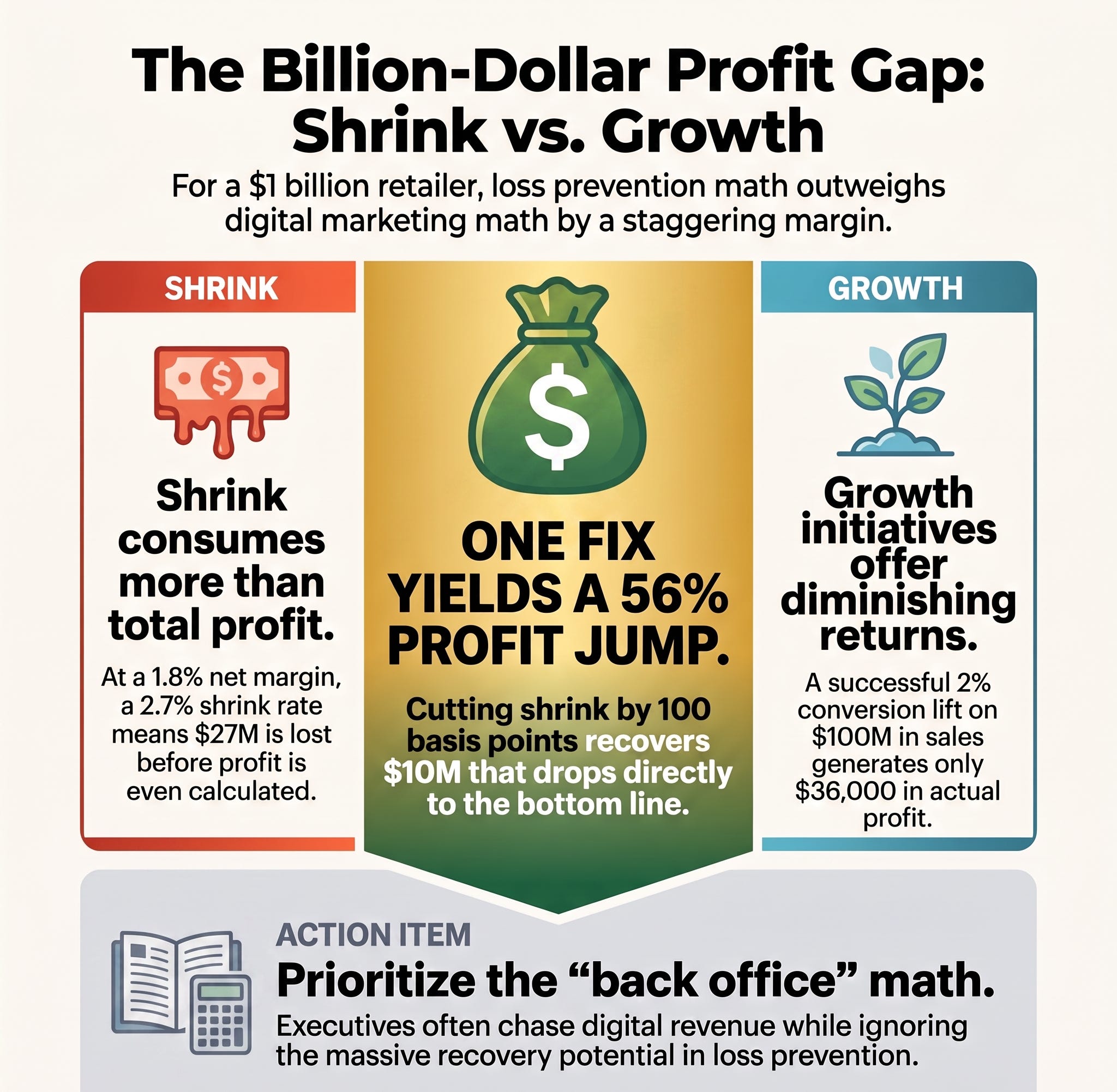
Cut shrink 100 basis points, from 2.7% to 1.7%, and you recover $10 million. That was money already spent on product that left the building and earned nothing. Getting it back drops almost straight to net income. Profit goes from $18 million to $28 million, a 56% jump from one fix.
Give the front office side its best case. A well-run personalization push drives a 2% conversion lift on $100 million in digital sales, a result most retailers would happily take. That’s $2 million in extra revenue. At a 1.8% margin, that’s about $36,000 in real profit, before licensing fees and the months it took to build.
Ten million against thirty-six thousand. I gave the front office example every benefit of the doubt, and the gap still isn’t close.
These usually come from different budgets and different teams, so it’s rarely a true either-or on the org chart. But someone still decides where the next dollar goes, and where the next round of exec attention goes, and that person is picking the wrong side of this math.
Where this leaves us
Grocery runs on thin margins and high volume. The operators still standing in five years won’t be the ones with the slickest app. They’ll be the ones who also fixed shrink, forecasting, and fulfillment while everyone else just demoed a chatbot on stage.
AI isn't a strategy here. It's a capability, and it only pays off when it's aimed at what's actually bleeding your margin.
Ten million dollars doesn't need a demo. It just needs someone to stop chasing the shiny things long enough to fix the boring ones.
Tell me where I'm wrong.
You Can’t Prompt Produce is a five-part series on how the AI grocers keep shipping, and most shoppers keep skipping.
“The Food Retailing Industry Speaks 2026.” FMI: https://www.fmi.org/our-research/research-reports/food-retailing-industry-speaks
“In the Trenches: Don’t blame produce managers for all the shrink.” The Produce News: https://theproducenews.com/headlines/trenches-dont-blame-produce-managers-all-shrink