


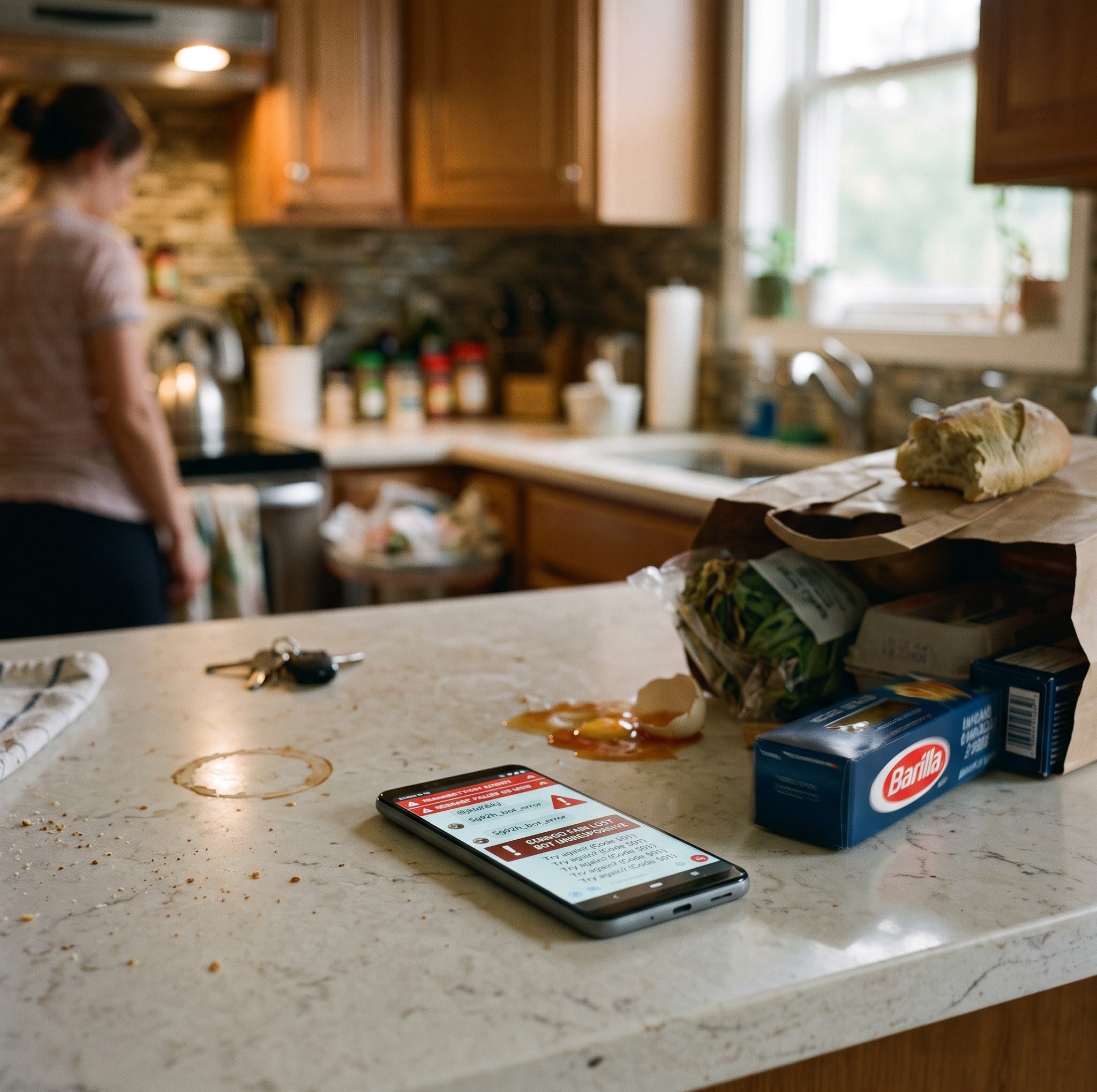
This is the third in a 5-part series, You Can’t Prompt Produce, on the AI grocers keep shipping, and most shoppers keep skipping.
TL;DR
Most shoppers still don’t trust AI with their groceries, and the data backs them up. Grocers often build or buy tools they haven't fully vetted. The failures that actually matter have nothing to do with the interface: stale inventory, bad substitutions, and hallucinated products. Run any chatbot through the six-point checklist at the end of this post before you launch or approve one.
Ask any grocery chatbot to rebuild last week’s order for your family, but now has a peanut allergy. Watch it recommend a snack bar that’s out of stock. Watch it swap in a “nut-free” substitute that isn’t, because nothing in that decision chain might have checked the label against the allergen flag.
That’s a real task. Complex tasks like meal planning, dietary restrictions, and rebuilding a cart from purchase history are exactly what a chatbot is supposed to do well. And it still gets it wrong.
Please note: this is NOT another rant against chatbots. They have an important role in securing future generations of loyal customers. It’s not “chat versus search for a gallon of milk.” Nobody’s trying to replace the produce grid with a text box, and no grocer is dumb enough to force that fight.
The focus is on ensuring your chatbot delivers the hard stuff it was built for.
Half the room hasn’t shown up
Even Walmart’s own research supports this. They found 47% of consumers would trust a digital agent to buy household essentials within a set budget. That number drops to 38% once you get specific about food and groceries, the lowest category they tested1. The company running the most visible AI shopping assistant in the country is telling you, in its own data, that groceries are the category people trust it with least.
And that’s despite real usage. Roughly half of Walmart’s app users have tried Sparky, and those users carry a noticeably higher average order value than the ones who don’t. So it’s not that nobody’s touching these tools. It’s that even heavy usage hasn’t closed the trust gap for the one category that matters most here.
Somebody else’s chatbot isn’t your chatbot
Here’s the part that gets skipped in the boardroom deck. National chains can build in-house, fund the engineering, and iterate on hallucinations weekly. Most regional and independent grocers can’t, and they know it.
That’s exactly why Associated Wholesale Grocers, a distributor, built a shared AI shopping tool, SmartMeals, in partnership with Breez AI, and handed it down to its independent grocery members2. Not because those grocers wanted a wholesaler’s chatbot. Because the alternative was falling further behind better-funded national chains with no realistic path to catch up on their own.

That’s the two-tier gap in its purest form. A middleman had to step in because small operators structurally can’t compete on this front alone, no matter how much they want to.
Where it actually breaks
Three specific failure modes keep showing up, and none of them are about typing being annoying.
Substitution logic is a known pain point across the industry. RetailWire’s coverage of online grocery substitutions found real, sustained shopper frustration, with cases where the replacement item sent wasn’t even a plausible stand-in for what was ordered3. That’s not a rare glitch. It’s a structural problem with how these systems guess at alternatives.
Inventory disconnection is the mechanical reason substitution keeps failing. Grocery inventory turns over multiple times a day, and pricing can shift within hours, but many retailers still only sync their product feeds overnight. A bot working off a stale feed will confidently recommend something that sold out that morning, and there’s no amount of clever prompting that fixes a data pipeline problem.
Hallucination is the third leg, and it’s the hardest to catch because it looks confident. The bot invents a product, a price, or a promotion that doesn’t exist, and the shopper only finds out at checkout.
The wrong answer costs more than a bad search result
There’s a reason getting this wrong stings more than a clunky menu. A shopper who hands a chatbot something complicated, such as a dietary restriction, a budget, or a week of dinners, is trusting it to think, not just to click. They’re not skimming a shelf on autopilot. They’re trusting the system to reason through something that actually matters.
When that trust gets a confident but wrong answer, the damage isn’t friction. It’s a shopper who bought the wrong bread for a kid with celiac disease because the tool she was told to rely on didn’t actually check.
The gap between the demo and the deployment
Vendors aren't lying when they show off a slick model in a sales meeting. They’re showing you the model’s ceiling, not the floor it hits once it’s stitched into your actual inventory system.
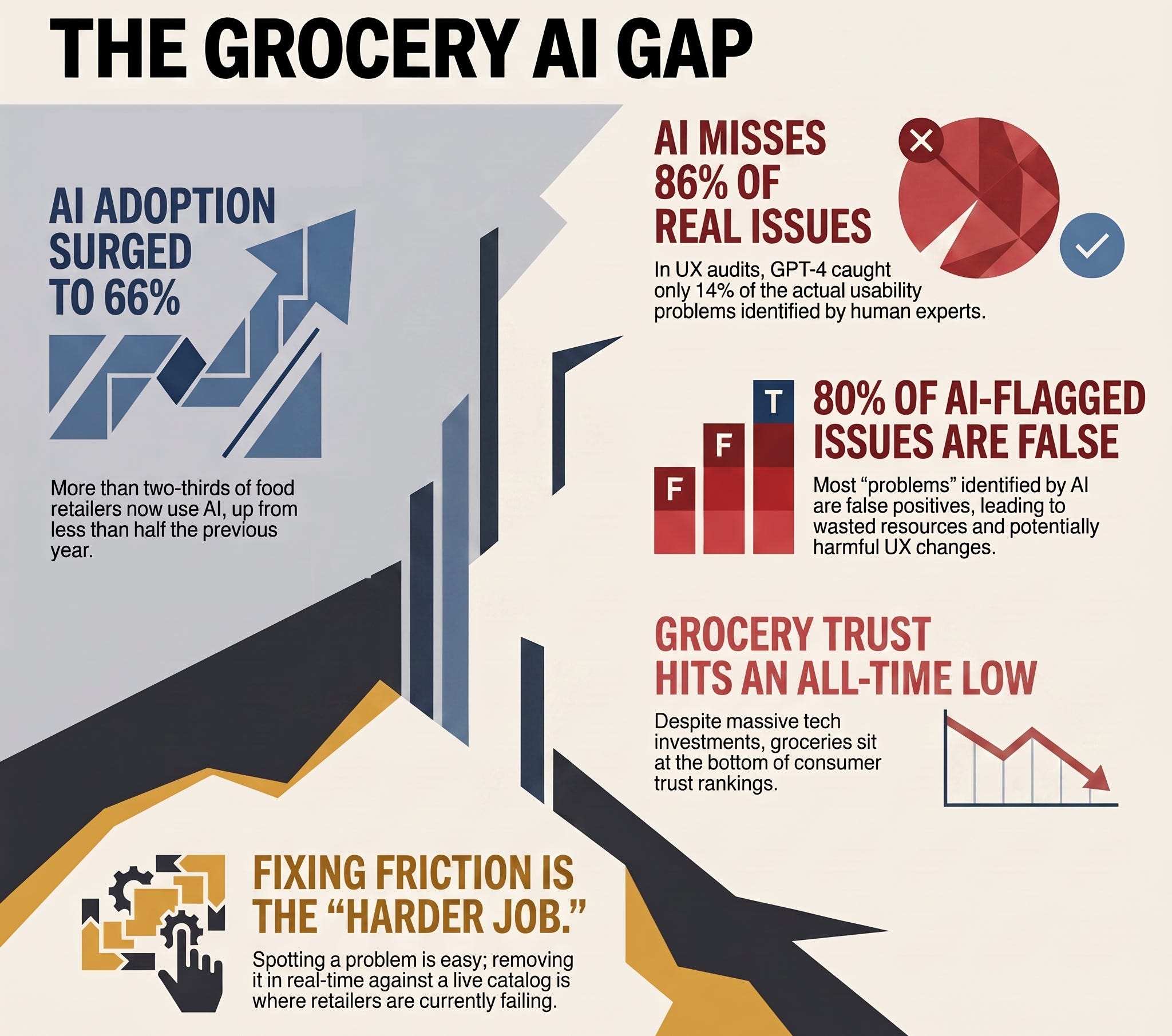
Baymard Institute ran a version of this test on the auditing side of the house. When they had GPT-4 evaluate live ecommerce pages against the same usability issues human experts had already found, the model caught only 14% of the real issues, and 80% of what it flagged was a false positive4. That’s the easier job: spotting a problem. The harder job, the one your chatbot is being asked to do, is not spotting friction but removing it in real time against a live catalog.
Retailers are moving faster than shoppers are willing to follow them. FMI’s early 2026 survey found more than two-thirds of food retailers now say they’re using AI, up from less than half the year before5. Meanwhile, groceries sit at the bottom of consumer trust in the very same Walmart data above. That gap will matter more than any individual product launch.
Build the chatbot worth trusting
Chat is a reasonable tool for genuinely ambiguous asks like meal planning around a budget, substitutions when shelves are empty, or shoppers working through dietary restrictions. These are genuinely hard problems, and language is a fine interface for solving them.
The mistake isn’t building a chatbot. It’s benchmarking yours against a company with ten times your data and a hundred times your engineering budget, then acting surprised when your version hallucinates a product or misses an allergy. Here’s what actually separates the two.
Sync your feed in real time. An overnight sync means the bot is recommending things that have already sold out. If yours updates in hours instead of minutes, find out why.
Write the substitution rules yourself. Leave allergen and diet swaps to a model’s guesswork and eventually something dangerous gets through, not just something annoying. Write the rules and own them.
Get a real number on how often it’s wrong. No vendor hallucination rate means no one’s actually measured it, and you’ll be the one who finds out in production. Ask what the bot does when it isn’t sure, too. A tool that always has an answer is worse than one that occasionally says it doesn’t know.
Figure out if it’s actually built for grocery. Plenty of what’s on the market is a general model wearing a grocery skin. This is usually where a national chain’s tool and everyone else’s start to look nothing alike.
Leave the door open, and ask if anyone wants in. Give shoppers a real way back to search and grids. And find out if they even want this before you bet the launch on it, because high usage with low satisfaction just means people feel stuck.
Decide what success looks like before you scale. Pick your baseline metric first: cart completion, time to checkout, number of complaints. Then put someone in charge of the failure log every week, with a number that actually triggers pulling the plug.
Get those six right, in-house or with a vendor, and you’ve got something people can rely on.
A downloadable version of these six rules, with supporting questions for each rule, is available on the Resources page.
Your turn, shoppers
What’s the dumbest thing a grocery AI has ever recommended, hallucinated, or gotten flat wrong for you? Maybe it swore an out-of-stock item was sitting in your cart, swapped in a substitute that ignored an allergy, or invented a price that never existed.
Drop it below.
You Can’t Prompt Produce is a five-part series on how the AI grocers keep shipping, and most shoppers keep skipping.
“Walmart’s Retail Rewired Report 2025: Agentic AI at the Heart of Retail Transformation.” Walmart: https://corporate.walmart.com/news/2025/06/04/walmarts-retail-rewired-report-2025-agentic-ai-at-the-heart-of-retail-transformation
“Harps Food Stores Aims to Redefine the Grocery Basket With AI-Driven Personalization.” The Packer: https://www.thepacker.com/news/retail/harps-food-stores-aims-redefine-grocery-basket-ai-driven-personalization
“How Can Substitutions Be Improved In Online Grocery?” RetailWire: https://retailwire.com/discussion/substitutions-improved-online-grocery
“Testing ChatGPT-4 for ‘UX Audits’ Shows an 80% Error Rate & 14–26% Discoverability Rate.” Baymard Institute: https://baymard.com/blog/gpt-ux-audit
“The Food Retailing Industry Speaks 2026.” FMI: https://www.fmi.org/newsroom/news-archive/view/2026/07/07/fmi-s-77th-annual-food-industry-analysis-finds-significant-investments-in-tech--enhancing-in-store-experience