



This is the second in a 5-part series, You Can’t Prompt Produce, on the AI grocers keep shipping, and most shoppers keep skipping.
TL;DR
Grocery boards keep funding GenAI pilots that never move a single P&L line, and it's not because they believe the ROI case. It's reputational insurance against showing up in a trade article as the retailer that did nothing. MIT and Gartner data both point to the same failure pattern, grocery's legacy ERPs and thin margins make it worse, and the fix isn't more AI strategy. It's three rules: name the metric before funding, set a 90-day kill clause, and fund back-office AI before anything customer-facing.
A grocery chain’s board approved a seven-figure budget for a GenAI pilot last year. Nobody on the exec team can tell you exactly which use case it was supposed to solve anymore. The tool is still live, but nobody’s opened it in months.
That’s not a hypothetical. It’s the default outcome across grocery right now, and the industry keeps issuing press releases like it isn’t happening.
Most of that capex never got signed off by “the board” in the vague way people like to blame. A CTO or CIO built the business case, a CFO signed the number, and the board wanted the comfort of knowing its company wasn’t the one that sat out.
Grocers still run on razor-thin net margins. That’s the environment these AI pilots got funded in, which makes the whole thing worse, not better.
Somewhere in a testing environment right now, a chatbot pilot from eighteen months ago is quietly dying. Nobody killed it. Nobody’s writing the postmortem. It just stopped coming up in the QBR.
That’s the graveyard. Almost nobody wants to admit how full it already is.
The Data Nobody Wants On The Board Slide
Here’s the number that should open every grocery AI strategy meeting instead of getting buried three slides deep in an appendix.
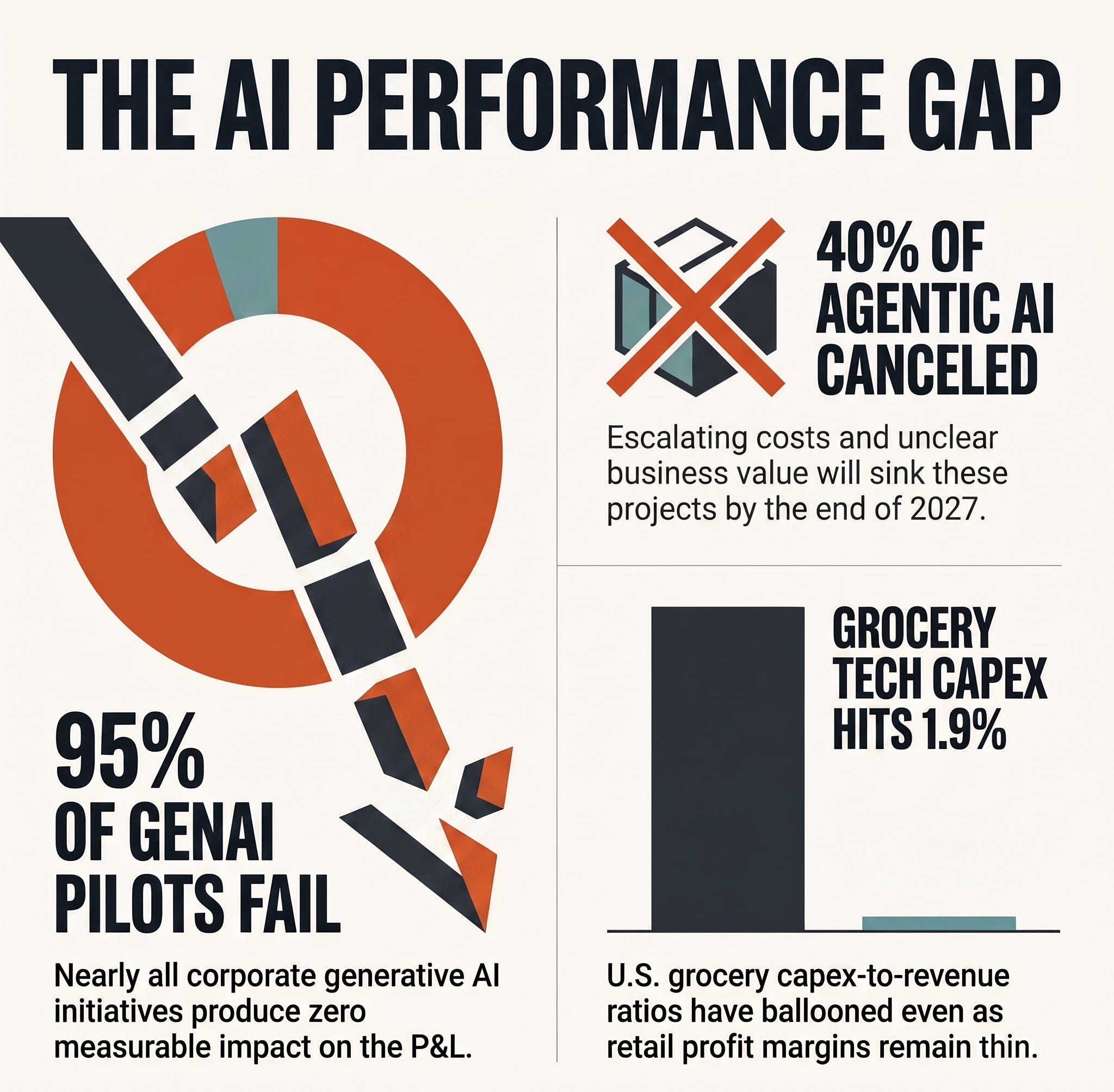
MIT’s NANDA initiative concluded that despite $30–$40 billion in enterprise AI investments, 95% of generative AI pilots produce zero measurable impact on the P&L.1 The researchers looked at the results of 300 publicly-disclosed AI deployments, surveyed 350 employees, and conducted 150 executive interviews. and the failure wasn’t about model quality. These failures largely came down to integration and priorities that never connected to an actual business problem.2
(Please note: this stat has taken its own share of hits since it went viral, with critics saying the methodology gets oversimplified. Fair warning before you drop it into a board deck cold. That said, it doesn’t undercut the pattern grocery operators are living through though, and the research below backs that up from a different angle.)
Gartner isn’t offering much cover either. Last year, the firm expected over 40% of agentic AI projects to be canceled by the end of 2027, blamed on ballooning costs, murky business value, and risk controls nobody bothered building before launch.3
Meanwhile, the money keeps moving. FMI reported that US grocery capex-to-revenue ratios have ballooned to 1.9%4 (with Walmart hitting 3.5% to 4%). Over 80% of food retailers are actively expanding technology spend to drive operational efficiency.
Capex is up, cancellation risk is also up, and most of what’s funded never touches the bottom line. This is not a strategy. It’s a lottery ticket with a seven-figure buy-in, and grocers keep buying more tickets.
Grocery also carries three handicaps most industries never have to deal with. Their ERPs are older than cloud computing itself, the supply chains have dozens of handoff points where data quality rots, and the industry margins are thin enough that a six-month ROI delay kills a pilot before it gets a fair shot.
None of that will shows up in the pitch deck.
The Boardroom Fight Nobody Talks About Publicly
Picture the room. A grocery CTO is staring down a renewal contract for a “predictive AI platform” that hasn’t moved a single operational metric yet.
Across the table, the vendor’s slide deck still says “transformational.” Their renewal ask is up 22% year over year. And nobody on that side has set foot in a distribution center floor since the deal closed.
The CTO asks the only question that matters: what did this move on shrink, forecast accuracy, labor hours saved? The answer pivots into softer language: foundational infrastructure, the next phase, features slated for “Q3” that were supposed to ship eighteen months ago.

The vendor can't answer because the pilot was never built to. It was built to answer a question asked a year earlier, several floors up: would this company show up in a trade article as the retailer that did nothing while a competitor announced an AI push?
The board bought insurance against that headline. That's reputational risk management, and it's why metric-free pilots are still getting funded a year after the failure data went public.
The CTO isn’t the villain. Neither is the vendor rep. Both are negotiating over a metric that was never the actual goal of the money behind it.
A pilot funded to protect a headline was never going to survive a real P&L review.
Three Rules For Killing Vanity AI Before It Kills Your Budget
Grocery leaders don’t need a new framework. They need permission to say no more often, and something better than a headline to hand the board.
No pilot gets funded without a named operational metric before day one. Shrink rate works. Forecast accuracy works. Labor hours per case picked works. If nobody can name the specific P&L line it’s supposed to move, it doesn’t get capex, it gets a whiteboard.
Every pilot gets a 90-day kill clause, no exceptions. That’s a hard date on the calendar. By day 90 the project shows a measurable delta against its named metric or it dies. Vendors will fight this one hard, and that fight is exactly how you know you’re negotiating seriously.
Back-office AI gets funded before anything customer-facing. Demand forecasting, inventory accuracy, shrink reduction, these have an actual ROI track record in grocery ops. Chatbots and generative shopping assistants photograph better in a board deck. They rarely pay for themselves.
None of this is complicated. It just gives a board something better than a headline to point to the next time a competitor announces its AI initiative. A capex rule nobody can second-guess in an earnings call beats a chatbot demo every time.
A one-page version of these three rules, with text to paste straight into a vendor contract review, is available on the Resources page.
Has your organization seen actual, measurable P&L yield from GenAI pilots, or are you just burning capex to satisfy the board?
You Can’t Prompt Produce is a five-part series on how the AI grocers keep shipping, and most shoppers keep skipping.
“The GenAI Divide, State of of AI in Business 2025.” MIT Nanda: https://mlq.ai/media/quarterly_decks/v0.1_State_of_AI_in_Business_2025_Report.pdf
“Why 95% Of AI Pilots Fail, And What Business Leaders Should Do Instead.” Forbes: https://www.forbes.com/sites/andreahill/2025/08/21/why-95-of-ai-pilots-fail-and-what-business-leaders-should-do-instead
“Gartner Predicts Over 40% of Agentic AI Projects Will Be Canceled by End of 2027.” Gartner: https://www.gartner.com/en/newsroom/press-releases/2025-06-25-gartner-predicts-over-40-percent-of-agentic-ai-projects-will-be-canceled-by-end-of-2027
“FMI Report: Food Industry Investing In Tech To Enhance In-Store Experience” The Shelby Report: https://theshelbyreport.com/2026/07/07/fmi-report-food-industry-investing-in-tech-to-enhance-in-store-experience